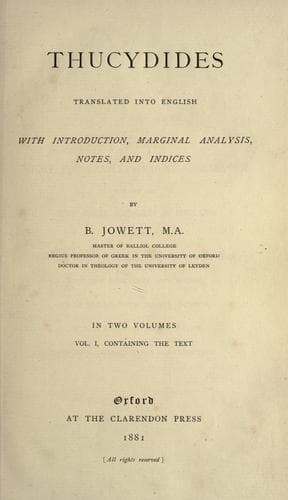
Greece -- History -- Peloponnesian War, 431-404 B.C.
“The long speech of the Athenians I do not pretend to understand. They
said a good deal in praise of themselves, but nowhere denied that they
are injuring our allies and Peloponnese. And yet if they behaved well
against the Mede then, but ill towards us now, they deserve double
punishment for having ceased to be good and for having become bad. We
meanwhile are the same then and now, and shall not, if we are wise,
disregard the wrongs of our allies, or put off till to-morrow the duty
of assisting those who must suffer to-day. Others have much money and
ships and horses, but we have good allies whom we must not give up to
the Athenians, nor by lawsuits and words decide the matter, as it is
anything but in word that we are harmed, but render instant and
powerful help. And let us not be told that it is fitting for us to
deliberate under injustice; long deliberation is rather fitting for
those who have injustice in contemplation. Vote therefore,
Lacedaemonians, for war, as the honour of Sparta demands, and neither
allow the further aggrandizement of Athens, nor betray our allies to
ruin, but with the gods let us advance against the aggressors.”
With these words he, as ephor, himself put the question to the assembly
of the Lacedaemonians. He said that he could not determine which was
the loudest acclamation (their mode of decision is by acclamation not
by voting); the fact being that he wished to make them declare their
opinion openly and thus to increase their ardour for war. Accordingly
he said: “All Lacedaemonians who are of opinion that the treaty has
been broken, and that Athens is guilty, leave your seats and go there,”
pointing out a certain place; “all who are of the opposite opinion,
there.” They accordingly stood up and divided; and those who held that
the treaty had been broken were in a decided majority. Summoning the
allies, they told them that their opinion was that Athens had been
guilty of injustice, but that they wished to convoke all the allies and
put it to the vote; in order that they might make war, if they decided
to do so, on a common resolution. Having thus gained their point, the
delegates returned home at once; the Athenian envoys a little later,
when they had dispatched the objects of their mission. This decision of
the assembly, judging that the treaty had been broken, was made in the
fourteenth year of the thirty years’ truce, which was entered into
after the affair of Euboea.
The Lacedaemonians voted that the treaty had been broken, and that the
war must be declared, not so much because they were persuaded by the
arguments of the allies, as because they feared the growth of the power
of the Athenians, seeing most of Hellas already subject to them.
CHAPTER IV
From the end of the Persian to the beginning of the Peloponnesian
War—The Progress from Supremacy to Empire
Public-domain text, read in full here on John Shaqi.
Reviews
Reviews
No reviews yet
Be the first to share your thoughts on this work.
Elsewhere in the archive
Join the Discussion
Join the discussion
Sign in to leave a comment or review.
Sign InorCreate an account