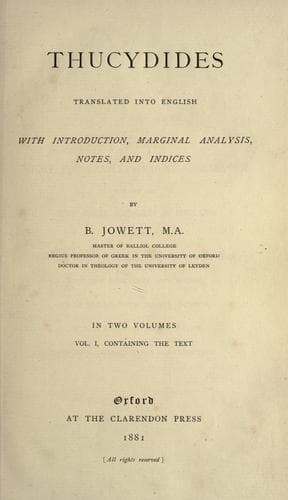
Greece -- History -- Peloponnesian War, 431-404 B.C.
After having rewarded him with a present of money, as soon as he
received some from his friends at Athens and from his secret hoards at
Argos, Themistocles started inland with one of the coast Persians, and
sent a letter to King Artaxerxes, Xerxes’s son, who had just come to
the throne. Its contents were as follows: “I, Themistocles, am come to
you, who did your house more harm than any of the Hellenes, when I was
compelled to defend myself against your father’s invasion—harm,
however, far surpassed by the good that I did him during his retreat,
which brought no danger for me but much for him. For the past, you are
a good turn in my debt”—here he mentioned the warning sent to Xerxes
from Salamis to retreat, as well as his finding the bridges unbroken,
which, as he falsely pretended, was due to him—“for the present, able
to do you great service, I am here, pursued by the Hellenes for my
friendship for you. However, I desire a year’s grace, when I shall be
able to declare in person the objects of my coming.”
It is said that the King approved his intention, and told him to do as
he said. He employed the interval in making what progress he could in
the study of the Persian tongue, and of the customs of the country.
Arrived at court at the end of the year, he attained to very high
consideration there, such as no Hellene has ever possessed before or
since; partly from his splendid antecedents, partly from the hopes
which he held out of effecting for him the subjugation of Hellas, but
principally by the proof which experience daily gave of his capacity.
For Themistocles was a man who exhibited the most indubitable signs of
genius; indeed, in this particular he has a claim on our admiration
quite extraordinary and unparalleled. By his own native capacity, alike
unformed and unsupplemented by study, he was at once the best judge in
those sudden crises which admit of little or of no deliberation, and
the best prophet of the future, even to its most distant possibilities.
An able theoretical expositor of all that came within the sphere of his
practice, he was not without the power of passing an adequate judgment
in matters in which he had no experience. He could also excellently
divine the good and evil which lay hid in the unseen future. In fine,
whether we consider the extent of his natural powers, or the slightness
of his application, this extraordinary man must be allowed to have
surpassed all others in the faculty of intuitively meeting an
emergency. Disease was the real cause of his death; though there is a
story of his having ended his life by poison, on finding himself unable
to fulfil his promises to the king. However this may be, there is a
monument to him in the marketplace of Asiatic Magnesia. He was governor
of the district, the King having given him Magnesia, which brought in
fifty talents a year, for bread, Lampsacus, which was considered to be
the richest wine country, for wine, and Myos for other provisions. His
Public-domain text, read in full here on John Shaqi.
Reviews
Reviews
No reviews yet
Be the first to share your thoughts on this work.
Elsewhere in the archive
Join the Discussion
Join the discussion
Sign in to leave a comment or review.
Sign InorCreate an account