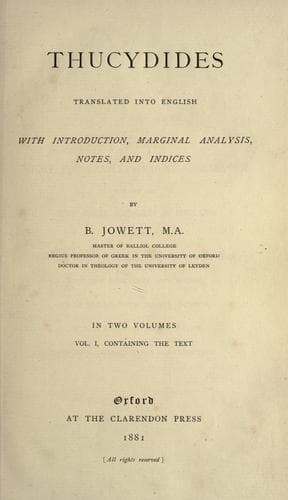
Greece -- History -- Peloponnesian War, 431-404 B.C.
“There is one principle, Athenians, which I hold to through everything,
and that is the principle of no concession to the Peloponnesians. I
know that the spirit which inspires men while they are being persuaded
to make war is not always retained in action; that as circumstances
change, resolutions change. Yet I see that now as before the same,
almost literally the same, counsel is demanded of me; and I put it to
those of you who are allowing yourselves to be persuaded, to support
the national resolves even in the case of reverses, or to forfeit all
credit for their wisdom in the event of success. For sometimes the
course of things is as arbitrary as the plans of man; indeed this is
why we usually blame chance for whatever does not happen as we
expected. Now it was clear before that Lacedaemon entertained designs
against us; it is still more clear now. The treaty provides that we
shall mutually submit our differences to legal settlement, and that we
shall meanwhile each keep what we have. Yet the Lacedaemonians never
yet made us any such offer, never yet would accept from us any such
offer; on the contrary, they wish complaints to be settled by war
instead of by negotiation; and in the end we find them here dropping
the tone of expostulation and adopting that of command. They order us
to raise the siege of Potidæa, to let Aegina be independent, to revoke
the Megara decree; and they conclude with an ultimatum warning us to
leave the Hellenes independent. I hope that you will none of you think
that we shall be going to war for a trifle if we refuse to revoke the
Megara decree, which appears in front of their complaints, and the
revocation of which is to save us from war, or let any feeling of
self-reproach linger in your minds, as if you went to war for slight
cause. Why, this trifle contains the whole seal and trial of your
resolution. If you give way, you will instantly have to meet some
greater demand, as having been frightened into obedience in the first
instance; while a firm refusal will make them clearly understand that
they must treat you more as equals. Make your decision therefore at
once, either to submit before you are harmed, or if we are to go to
war, as I for one think we ought, to do so without caring whether the
ostensible cause be great or small, resolved against making concessions
or consenting to a precarious tenure of our possessions. For all claims
from an equal, urged upon a neighbour as commands before any attempt at
legal settlement, be they great or be they small, have only one
meaning, and that is slavery.
Public-domain text, read in full here on John Shaqi.
Reviews
Reviews
No reviews yet
Be the first to share your thoughts on this work.
Elsewhere in the archive
Join the Discussion
Join the discussion
Sign in to leave a comment or review.
Sign InorCreate an account