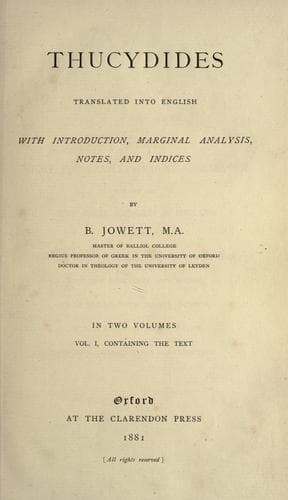
Greece -- History -- Peloponnesian War, 431-404 B.C.
On becoming aware of the presence of the Thebans within their gates,
and of the sudden occupation of the town, the Plataeans concluded in
their alarm that more had entered than was really the case, the night
preventing their seeing them. They accordingly came to terms and,
accepting the proposal, made no movement; especially as the Thebans
offered none of them any violence. But somehow or other, during the
negotiations, they discovered the scanty numbers of the Thebans, and
decided that they could easily attack and overpower them; the mass of
the Plataeans being averse to revolting from Athens. At all events they
resolved to attempt it. Digging through the party walls of the houses,
they thus managed to join each other without being seen going through
the streets, in which they placed wagons without the beasts in them, to
serve as a barricade, and arranged everything else as seemed convenient
for the occasion. When everything had been done that circumstances
permitted, they watched their opportunity and went out of their houses
against the enemy. It was still night, though daybreak was at hand: in
daylight it was thought that their attack would be met by men full of
courage and on equal terms with their assailants, while in darkness it
would fall upon panic-stricken troops, who would also be at a
disadvantage from their enemy’s knowledge of the locality. So they made
their assault at once, and came to close quarters as quickly as they
could.
The Thebans, finding themselves outwitted, immediately closed up to
repel all attacks made upon them. Twice or thrice they beat back their
assailants. But the men shouted and charged them, the women and slaves
screamed and yelled from the houses and pelted them with stones and
tiles; besides, it had been raining hard all night; and so at last
their courage gave way, and they turned and fled through the town. Most
of the fugitives were quite ignorant of the right ways out, and this,
with the mud, and the darkness caused by the moon being in her last
quarter, and the fact that their pursuers knew their way about and
could easily stop their escape, proved fatal to many. The only gate
open was the one by which they had entered, and this was shut by one of
the Plataeans driving the spike of a javelin into the bar instead of
the bolt; so that even here there was no longer any means of exit. They
were now chased all over the town. Some got on the wall and threw
themselves over, in most cases with a fatal result. One party managed
to find a deserted gate, and obtaining an axe from a woman, cut through
the bar; but as they were soon observed only a few succeeded in getting
out. Others were cut off in detail in different parts of the city. The
most numerous and compact body rushed into a large building next to the
city wall: the doors on the side of the street happened to be open, and
the Thebans fancied that they were the gates of the town, and that
there was a passage right through to the outside.
Public-domain text, read in full here on John Shaqi.
Reviews
Reviews
No reviews yet
Be the first to share your thoughts on this work.
Elsewhere in the archive
Join the Discussion
Join the discussion
Sign in to leave a comment or review.
Sign InorCreate an account