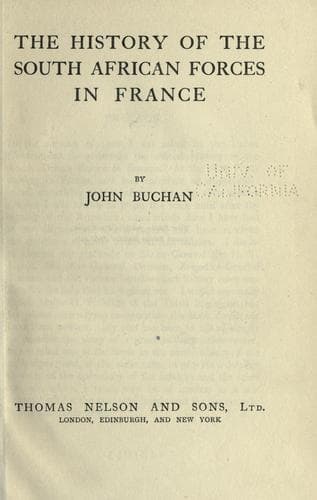
The history of the South African forces in FranceBuchan, John
History
The history of the South African forces in France
Buchan, John
South Africa. Army; World War, 1914-1918 -- Campaigns -- France; World War, 1914-1918 -- Regimental histories -- South Africa
While we leave the South Africans secure for the moment in the Green Line
we must note what happened elsewhere that day on the battle-front. Byng
had been the less heavily engaged, and during the day yielded little
ground. The enemy’s main effort was against the Fifth Army, especially
at the three critical points of the Cologne and Omignon valleys and
the Crozat Canal. By midday the canal had been lost, and early in the
afternoon Gough was almost everywhere in the third defensive zone. By
the evening that zone had been broken around Vaux and Beauvois. Our
last reserves had been thrown in, and, save for a French division and
some French cavalry, now heavily engaged on the Crozat Canal, there was
no help available for the hard-pressed Fifth Army. The gaps could not
be stopped, so at all costs our front must withdraw. At 11 p.m. that
night Gough gave orders to fall back to the bridgehead position east of
the Somme, a position which, as we have seen, was not yet completed.
Maxse’s XVIII. Corps was to retire to the river line; Watts’ XIX. Corps
and Congreve’s VII. Corps were to hold the Péronne bridgehead on a line
running from Voyennes through Monchy-Lagache to Vraignes, and thence
continue in the third zone to the junction with the Third Army at
Equancourt. This compelled Byng to fall back to conform, and his front
ran now in the third zone to Hénin-sur-Cojeul, whence the old battle zone
was continued to Fampoux.
The third zone was nowhere a real defence, and presently it was clear
that the Péronne bridgehead was little better. During the thick night,
while the divisions of the Fifth Army, now in the last stages of fatigue,
struggled westward, Gough was faced with a momentous decision. He now
knew the weight of the German attack; his right flank was in desperate
peril; he had no hope of support for several days; and his men strung
out on an immense front had been fighting without rest for forty-eight
hours. If he faced a general engagement on the morrow he might suffer
decisive defeat. There seemed no course open to him but to abandon the
Péronne bridgehead, and fall back behind the river. It was a difficult
decision, for it shortened our time for defending the river line and for
clearing troops and material from the east bank. But the alternative
was certain disaster, and beyond doubt in the circumstances Gough’s
judgment was right. Accordingly, very early on the morning of Saturday,
the 23rd March, instructions were given to Watts to withdraw gradually to
the river line, while Congreve, on his left, was to take up a position
between Doingt and Nurlu. The front of the VII. Corps would now just
cover Péronne on the north, and it would have behind it, flowing from
north to south, the little river Tortille.
[Sidenote: _March 23._]
Public-domain text, read in full here on John Shaqi.
Reviews
Reviews
No reviews yet
Be the first to share your thoughts on this work.
Elsewhere in the archive
Join the Discussion
Join the discussion
Sign in to leave a comment or review.
Sign InorCreate an account