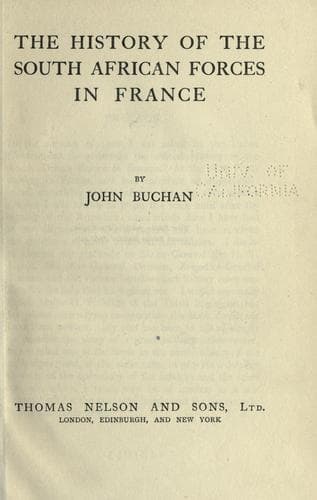
The history of the South African forces in FranceBuchan, John
History
The history of the South African forces in France
Buchan, John
South Africa. Army; World War, 1914-1918 -- Campaigns -- France; World War, 1914-1918 -- Regimental histories -- South Africa
General Tudor told Dawson that instructions had come for the division to
withdraw after dark to a position on the line from Government Farm by
the east of St. Pierre Vaast Wood to the road just west of Bouchavesnes
which led to Cléry. He informed him that Sir Walter Congreve had ordered
that this line must be held “at all costs,” and added that he presumed,
if it was broken, it would be retaken by a counter-attack. These words
of Tudor’s are of importance, for they were Dawson’s charter for the
fighting of the next day. He was also bidden keep in close touch with
the troops on his right—a counsel of perfection hard to follow, for
Gough’s decision on the night of the 22nd involved an indefinite retreat
westward, and in such circumstances a unit which had orders to stand at
all costs must inevitably be left in the void. Dawson saw his commanding
officers, Heal and Christian (the remnants of the 4th had now been
attached to the 2nd), and explained to them the gravity of the position.
Whoever retired, the Brigade must stand.
The withdrawal started at 9.45 p.m., and the last troops had begun their
retreat by 11 p.m. At 3 a.m. on the morning of the 24th all were in
position in the new line. It was not the line which General Tudor had
indicated, for by this time the left brigade of the 21st Division was
more than a mile westward of that front, and if the South Africans were
to stand they must find ground which, at any rate to begin with, was not
hopelessly untenable. Dawson decided to occupy a ridge some 1,500 yards
west of Tudor’s line, so that by throwing back his right flank he might
reduce the gap between him and the 21st to a less dangerous size. His
Brigade Major, Cochran, was sent to prospect the position while it was
still light, and to get into touch with the neighbouring Brigadier of
the 21st, from whom he learned that immediately after dark that brigade
intended to make a further retirement. In the South African withdrawal
some of the posts flung out on the right flank lost their way, and
wandered back to the transport lines. They were destined to be among
the few survivors. During the night touch was obtained with the 21st
Division, which, after retiring, had again advanced. The left flank of
the Brigade was in touch with a company of the 6th K.O.S.B. of the 27th
Brigade. The situation on that flank, however, was far from secure, for
the K.O.S.B. did not know the whereabouts of the rest of their battalion
or of their brigade. Dawson sent out patrols to look for them, but there
was no sign of them anywhere in the countryside.
[Sidenote: _March 24._]
Public-domain text, read in full here on John Shaqi.
Reviews
Reviews
No reviews yet
Be the first to share your thoughts on this work.
Elsewhere in the archive
Join the Discussion
Join the discussion
Sign in to leave a comment or review.
Sign InorCreate an account