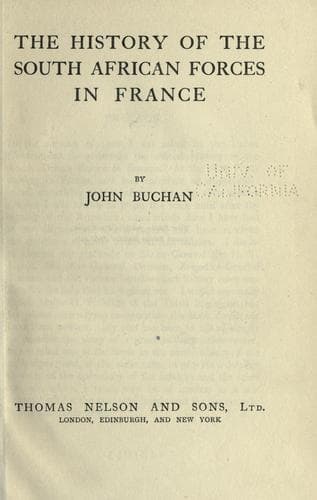
The history of the South African forces in FranceBuchan, John
History
The history of the South African forces in France
Buchan, John
South Africa. Army; World War, 1914-1918 -- Campaigns -- France; World War, 1914-1918 -- Regimental histories -- South Africa
The loss of the Messines Ridge, though the 9th Division was still
standing south of Hollebeke and at Wytschaete, compelled Plumer to
rearrange his front. Early on the night of the 11th he relinquished
Nieppe, retiring the 34th Division to the neighbourhood of Pont
d’Echelles. This involved the falling back of the 25th and 19th Divisions
to a front about 1,000 yards east of Neuve Eglise and Wulverghem, and the
consequent abandonment of the important point, Hill 63, just north of the
western extremity of Ploegsteert Wood. South of the Lys there had been
heavy fighting. The line of the Lawe had been lost, and by this time the
enemy was in Merville. That night the British front ran from Givenchy to
Locon, west of Merville, west of Neuf Berquin, north of Steenwerck and
Nieppe, east of Neuve Eglise and Wulverghem, west of Messines, and along
the ridge just covering Wytschaete. The gate was open, but it was narrow,
and the gate-posts still held.
[Sidenote: _April 12._]
About four on the afternoon of the 11th orders had been received from
the 19th Division for a general withdrawal. The South Africans were to
fall back to a line from North Midland Farm by Kruisstraat Cabaret and
Spanbroekmolen to Maedelstaede Farm, with the 108th Brigade on their
right and the 57th in reserve along the Neuve Eglise-Kemmel road. About
eight o’clock the Germans were found to be working round the left flank
in the vicinity of L’Enfer, and accordingly two companies of the 1st
Royal Irish Fusiliers from the 108th Brigade were sent to the north
of L’Enfer to obtain touch with the 9th Division. For the rest, the
withdrawal was carried out without incident. By 5 a.m. on the 12th the
South Africans were in their new front.
Up to now the enemy had not used more than sixteen divisions; but on
the morning of Friday, the 12th, he began to throw in his reserves at
a furious pace. Elated by his rapid success, he turned what was meant
as a diversion into a major operation, and dreamed of Boulogne and
Calais. It was Ludendorff’s first blunder, and it was fatal. It saved
the Allied front, but for the moment it all but destroyed the British
army. Our reinforcements were arriving from the south, but they could
only gradually come into line. That day the enemy came very near to
crossing the La Bassée Canal. He made an ugly gap in our line south-west
of Bailleul, which let through detachments, who seized Merris and
Oultersteene north of the railway. He was now close on Bailleul Station,
pushing direct for Hazebrouck, and but for a gallant stand of a brigade
of the 33rd Division, would have been through the breach. In the section
of the 9th and 19th Divisions nothing happened. The enemy, having gained
the Messines Ridge, was apparently content to rest there for a time, and
made no further attack.
[Sidenote: _April 13._]
Public-domain text, read in full here on John Shaqi.
Reviews
Reviews
No reviews yet
Be the first to share your thoughts on this work.
Elsewhere in the archive
Join the Discussion
Join the discussion
Sign in to leave a comment or review.
Sign InorCreate an account