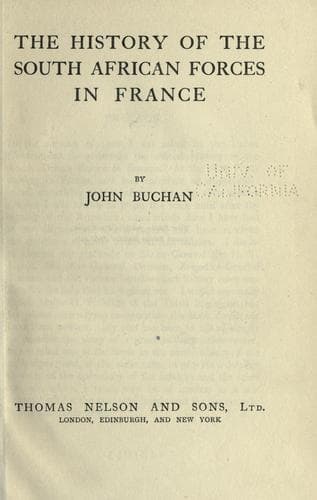
The history of the South African forces in FranceBuchan, John
History
The history of the South African forces in France
Buchan, John
South Africa. Army; World War, 1914-1918 -- Campaigns -- France; World War, 1914-1918 -- Regimental histories -- South Africa
The first objective having been taken, the 199th Brigade, according to
plan, took up the attack, leap-frogging the South African and 198th
Brigades, and by 11 a.m. had taken Serain and reached the final line.
For a little its left flank was exposed, for Villers-Outréaux was still
in German hands. By three in the afternoon, however, the V. Corps had
succeeded in carrying that village, and the XIII. Corps was able to
establish itself securely east of Prémont and Serain. It had been a day
of unblemished success. Haig and Débeney had advanced between three and
four miles, and the Siegfried zone had disappeared in a cataclysm. The
enemy was falling back to the Oise and the Selle, and for the moment was
in dire confusion. Every road converging upon Le Cateau was blocked with
troops and transport, and our cavalry were galloping eastward to harass
the retreat. Next day Cambrai fell, and the Germans retired behind the
line of the Selle. The war of positions had ceased, and the combatants
were now in open country.
[Sidenote: _Oct. 9._]
On the 9th Byng and Rawlinson pressed their advantage against the
stricken enemy, who had no position on which he could stand, short of
the Selle river. The South Africans began the day in reserve, the attack
on Maretz being conducted by the 198th and 199th Brigades. By 10 o’clock
Maretz, Avelu, and Elincourt had fallen, and half an hour later the South
Africans passed through the two brigades and moved against the second
objective, a line east of Maurois and Honnechy and Gattignies Wood. There
was some hope that before nightfall the crossings of the Selle might be
seized and the ridge to the east, which, it was clear, were the immediate
objects of the German retreat. But though the enemy was disordered,
he was not in rout, and his machine gunners fought stubborn rearguard
actions. The 2nd Regiment on the right, now under Major Sprenger, came
under heavy fire as soon as it emerged from the eastern skirts of Maretz.
As its left approached Gattignies Wood, it was strongly opposed by
machine guns and snipers, but by the assistance of two armoured cars the
southern part of the wood was cleared. On the right the advance was held
up for half an hour by enemy posts along the Le Cateau railway. To add to
Sprenger’s difficulties, the 4th Regiment, under MacLeod, on his left was
compelled to veer north towards Bertry, since the troops on its left had
fallen slightly behind and got out of touch. He was compelled to bring up
one of his supporting companies, and presently established his line on
the Cambrai railway, where many machine guns and prisoners were taken.
Before him lay the villages of Maurois and Honnechy, which appeared
to be lightly held, since some of the houses were flying white flags.
Sprenger, with three companies in line and one in support, moved through
the village with little opposition, and was received with wild enthusiasm
by the French inhabitants. It was the first time the South Africans had
Public-domain text, read in full here on John Shaqi.
Reviews
Reviews
No reviews yet
Be the first to share your thoughts on this work.
Elsewhere in the archive
Join the Discussion
Join the discussion
Sign in to leave a comment or review.
Sign InorCreate an account