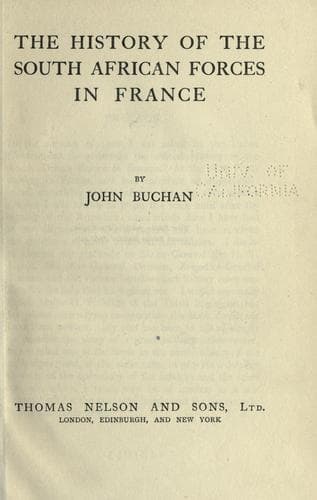
The history of the South African forces in FranceBuchan, John
History
The history of the South African forces in France
Buchan, John
South Africa. Army; World War, 1914-1918 -- Campaigns -- France; World War, 1914-1918 -- Regimental histories -- South Africa
Zero hour for the 50th Division was 5.20 a.m., for it had much ground to
cover before it could come into line with the 66th. The 151st Brigade
crossed the river with ease, but met with a stubborn resistance at
the station. The 149th Brigade followed for the attack on the second
objective, and found like difficulties at the railway triangle. So soon
as the news came that the 149th was over the Selle, it was time for the
South Africans to advance. The Brigade had taken immense risks in its
assembly, and escaped serious loss partly by the help of the fog, partly
by the very boldness of the hazard, since it lay so close to the enemy
that his fire was ineffective. But it was a welcome relief to officers
and men when at 8.5 a.m. came the order to launch the attack.
The mist was still thick, and no man could see fifty yards before him.
The first wave disappeared into the gloom, and those behind waited long
before they got news of it. From the outset the attack had to face great
belts of single and double apron wire, and heavy machine-gun fire from
both flanks. After a hundred yards had been covered, the South Africans
came upon a sunken road protected by a palisade, where the 4th Regiment
was held up for some time, and suffered many losses. As they approached
the railway they encountered another and more formidable obstacle—a belt
of wire entanglements sixty yards deep. The railway at this point ran in
a deep cutting, the sides of which were studded with machine-gun posts
and rifle-pits. The South Africans rose to the emergency. They found a
shallow trench used by the Germans as a route from the railway cutting
to an outpost; they found a tortuous path through the wire made for the
use of German patrols, where Major Clerk of the 4th Regiment shot the two
sentries on duty; and by these roads slowly and patiently they filtered
through to the railway. It was a magnificent feat of cool resolution,
and it was performed under the most galling fire. Soon they were in the
cutting, where stern fighting took place. It was Ludendorff’s old device
of “infiltration” in miniature, and at 9.15 Captain Jacobs of the 2nd
Regiment reported to Major Sprenger that the first objective had been
reached.
Public-domain text, read in full here on John Shaqi.
Reviews
Reviews
No reviews yet
Be the first to share your thoughts on this work.
Elsewhere in the archive
Join the Discussion
Join the discussion
Sign in to leave a comment or review.
Sign InorCreate an account