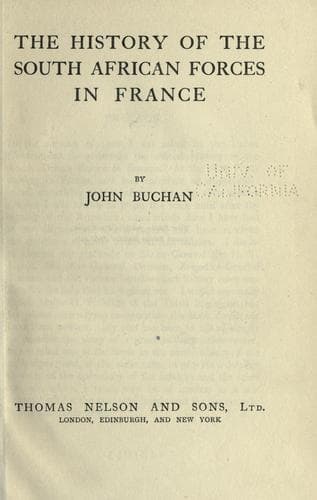
The history of the South African forces in FranceBuchan, John
History
The history of the South African forces in France
Buchan, John
South Africa. Army; World War, 1914-1918 -- Campaigns -- France; World War, 1914-1918 -- Regimental histories -- South Africa
At east of YPRES on September 20, 1917. For most conspicuous bravery
during operations. Lance-Corporal Hewitt attacked a “pill-box” with his
section and tried to rush the doorway. The garrison, however, proved
very stubborn, and in the attempt this non-commissioned officer received
a severe wound. Nevertheless, he proceeded to the loophole of the
“pill-box” where, in his attempts to put a bomb into it, he was again
wounded in the arm. Undeterred, however, he eventually managed to get
a bomb inside, which caused the occupants to dislodge, and they were
successfully and speedily dealt with by the remainder of the section.
SECOND-LIEUTENANT (ACTING CAPTAIN) ARTHUR MOORE LASCELLES, 3rd (attached
14th) Battalion, Durham Light Infantry.
At MASNIÈRES, France, on December 3, 1917. For most conspicuous bravery,
initiative, and devotion to duty when in command of his company in a very
exposed position. After a very heavy bombardment, during which Captain
Lascelles was wounded, the enemy attacked in strong force but was driven
off, success being due in a great degree to the fine example set by this
officer, who, refusing to allow his wound to be dressed, continued to
encourage his men and organize the defence.
Shortly afterwards the enemy again attacked and captured the trench,
taking several of his men prisoners. Captain Lascelles at once jumped on
the parapet, and followed by the remainder of his company, twelve men
only, rushed across under very heavy machine-gun fire and drove over
sixty of the enemy back, thereby saving a most critical situation.
He was untiring in reorganizing the position, but shortly afterwards the
enemy again attacked and captured the trench and Captain Lascelles, who
escaped later. The remarkable determination and gallantry of this officer
in the course of operations, during which he received two further wounds,
afforded an inspiring example to all.
CAPTAIN OSWALD AUSTIN REID, 2nd Battalion, Liverpool Regiment, attached
6th Battalion, Loyal North Lancashire Regiment.
At DIALAH RIVER, Mesopotamia, on March 8-10, 1917. For most conspicuous
bravery in the face of desperate circumstances. By his dauntless courage
and gallant leadership he was able to consolidate a small post with the
advanced troops, on the opposite side of a river to the main body, after
his lines of communication had been cut by the sinking of the pontoons.
He maintained this position for thirty hours against constant attacks by
bombs, machine-gun and shell fire, with the full knowledge that repeated
attempts at relief had failed, and that his ammunition was all but
exhausted. It was greatly due to his tenacity that the passage of the
river was effected on the following night. During the operations he was
wounded.
MAJOR (ACTING LIEUTENANT-COLONEL) JOHN SHERWOOD-KELLY, C.M.G., D.S.O.,
Norfolk Regiment, Commanding 1st Battalion, Royal Inniskilling Fusiliers.
Public-domain text, read in full here on John Shaqi.
Reviews
Reviews
No reviews yet
Be the first to share your thoughts on this work.
Elsewhere in the archive
Join the Discussion
Join the discussion
Sign in to leave a comment or review.
Sign InorCreate an account