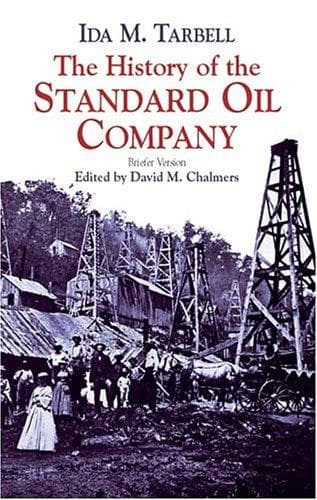
The History of the Standard Oil CompanyTarbell, Ida M. (Ida Minerva)
History
The History of the Standard Oil Company
Tarbell, Ida M. (Ida Minerva)
Petroleum industry and trade -- United States -- History; Standard Oil Company -- History
All over the country the refineries in the same condition as Mr. Tack’s
firm sold or leased. Those who felt the hard times and had any hope of
weathering them resisted at first. With many of them the resistance was
due simply to their love for their business and their unwillingness to
share its control with outsiders. The thing which a man has begun, cared
for, led to a healthy life, from which he has begun to gather fruit,
which he knows he can make greater and richer, he loves as he does his
life. It is one of the fruits of his life. He is jealous of it—wishes
the honour of it, will not divide it with another. He can suffer heavily
his own mistakes, learn from them, correct them. He can fight
opposition, bear all—so long as the work is his. There were refiners in
1875 who loved their business in this way. Why one should love an oil
refinery the outsider may not see; but to the man who had begun with one
still and had seen it grow by his own energy and intelligence to ten,
who now sold 500 barrels a day where he once sold five, the refinery was
the dearest spot on earth save his home. He walked with pride among its
evil-smelling places, watched the processes with eagerness, experimented
with joy and recounted triumphantly every improvement. To ask such a man
to give up his refinery was to ask him to give up the thing which, after
his family, meant most in life to him.
To Mr. Rockefeller this feeling was a weak sentiment. To place love of
independent work above love of profits was as incomprehensible to him as
a refusal to accept a rebate because it was _wrong_! Where persuasion
failed then, it was necessary, in his judgment, that pressure be
applied—simply a pressure sufficient to demonstrate to these blind or
recalcitrant individuals the impossibility of their long being able to
do business independently. It was a pressure varied according to
locality. Usually it took the form of cutting their market. The system
of “predatory competition” was no invention of the Standard Oil Company.
It had prevailed in the oil business from the start. Indeed, it was one
of the evils Mr. Rockefeller claimed his combination would cure, but
until now it had been used spasmodically. Mr. Rockefeller never did
anything spasmodically. He applied underselling for destroying his
rivals’ market with the same deliberation and persistency that
characterised all his efforts, and in the long run he always won. There
were other forms of pressure. Sometimes the independents found it
impossible to get oil; again, they were obliged to wait days for cars to
ship in; there seemed to be no end to the ways of making it hard for men
to do business, of discouraging them until they would sell or lease, and
always at the psychological moment a purchaser was at their side. Take
as an example the case of the Harkness refinery in Philadelphia, a story
told to the same committee as that of Mr. Tack:
Public-domain text, read in full here on John Shaqi.
Reviews
Reviews
No reviews yet
Be the first to share your thoughts on this work.
Elsewhere in the archive
Join the Discussion
Join the discussion
Sign in to leave a comment or review.
Sign InorCreate an account