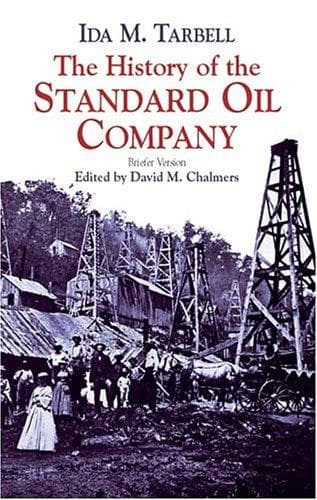
The History of the Standard Oil CompanyTarbell, Ida M. (Ida Minerva)
History
The History of the Standard Oil Company
Tarbell, Ida M. (Ida Minerva)
Petroleum industry and trade -- United States -- History; Standard Oil Company -- History
But in the spring of 1878 Mr. Rockefeller and his colleagues instituted
a series of manœuvres which shattered the last remnant of confidence the
oil men had in the sincerity of their claim that they were doing their
utmost to relieve the distressed Oil Regions, and that their measures
were necessary to hold the producers in check. The pipe-lines began to
refuse to load cars for the shippers who supplied the few independent
refiners with oil. The experiences of many of these independent oil men
have been told before the courts. For instance, W. H. Nicholson, the
representative of Mr. Ohlen, of New York, a shipper of petroleum,
testified[69] that in May, 1878, he began to have difficulty in getting
cars. At Olean, one day, Mr. Ohlen telegraphed to the officials of the
Erie road to know if he could get 100 cars to run East. The reply came
back, Yes. About noon, Mr. Nicholson says, he saw Mr. O’Day, the manager
of the United Pipe Lines, in which his oil was stored, and told him that
he was waiting to have his cars loaded. Mr. O’Day at once said he could
not load the cars. “But I have an order from the Erie officials, giving
me the cars,” Mr. Nicholson objected. “That makes no difference,” O’Day
replied; “I cannot load cars except upon an order from Pratt.” Nor would
he do it. The cars were not loaded for Mr. Nicholson, although at that
time he had ten thousand barrels of oil in the United Pipe Lines, and an
order for 100 cars from the officials of the Erie road in his hand.
B. B. Campbell, at that time president of the Producers’ Union, gave his
experience at this time in the suit of the Commonwealth against the
Pennsylvania Railroad:
I never heard of a scarcity of cars until the early part of June,
1878; I came to Parker about five o’clock in the evening, and found
the citizens in a state of terrible excitement; the Pipe-Lines would
not run oil unless it was sold; the only shippers we had in Parker
of any amount, viz., the agents of the Standard Oil Company, would
not buy oil, stating that they could not get cars; hundreds of wells
were stopped to their great injury; thousands more, whose owners
were afraid to stop them for fear of damage by salt-water, were
pumping the oil on the ground. I used all the influence I had to
prevent an outbreak and destruction of railroad and pipe-lines; I at
once went over to the Allegheny Valley Railroad office and
telegraphed to John Scott, president of the Allegheny Valley
Railroad Company:
“‘The refusal of the United to run oil unless sold upon immediate
shipment, and of the railroad to furnish cars, has created such a
degree of excitement here that the more conservative part of the
citizens will not be able to control the peace, and I fear that the
scenes of last July will be repeated on an aggravated scale.’ That
message I left in the office about seven o’clock in the evening. I
got up the next morning before seven and received an answer:
Public-domain text, read in full here on John Shaqi.
Reviews
Reviews
No reviews yet
Be the first to share your thoughts on this work.
Elsewhere in the archive
Join the Discussion
Join the discussion
Sign in to leave a comment or review.
Sign InorCreate an account