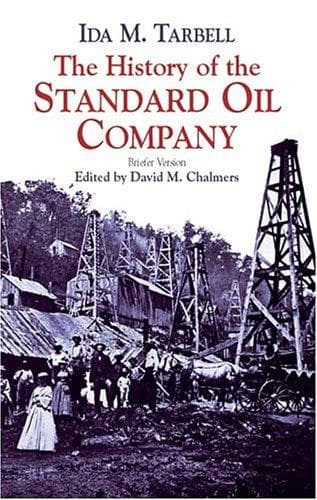
The History of the Standard Oil CompanyTarbell, Ida M. (Ida Minerva)
History
The History of the Standard Oil Company
Tarbell, Ida M. (Ida Minerva)
Petroleum industry and trade -- United States -- History; Standard Oil Company -- History
The same or similar conditions, not only in oil, but in other products,
which led to these suits, led to investigations in other states. Toward
the end of 1878 the Chamber of Commerce of New York City demanded from
the Legislature of the state an investigation of the New York railroads.
This investigation was carried on from the beginning of 1879. The
revelations were amazing. Before the Hepburn Commission, as it was
called from the name of the chairman, was through with its work there
had appeared before it to give testimony in regard to the conduct of the
Standard Oil Company and of the relation of the Erie and the Central
roads to it, H. H. Rogers, J. D. Archbold, Jabez A. Bostwick and W. T.
Sheide. A large number of independent oil men had also appeared. William
H. Vanderbilt had been examined, and G. H. Blanchard, the freight agent
of the Erie road, had given a full account of the relation of the Erie
to the Standard, perhaps the most useful piece of testimony, after that
of Mr. Cassatt, belonging to this period of the Standard’s history.[73]
At the same time that the Pennsylvania suits were going on, and the
Hepburn Commission was doing its work, the Legislature of Ohio
instituted an investigation. It was commonly charged that this
investigation was smothered, but it was not smothered until H. M.
Flagler had appeared before it and given some most interesting facts
concerning rebates. A number of gentlemen who were finding it hard to do
oil business also appeared before the Ohio committee and told their
stories.[74] By April, 1879, there had been brought out in these various
investigations a mass of testimony sufficient in the judgment of certain
of the producers to establish the truth of a charge which they had long
been making, and that was that the Standard was simply a revival of the
South Improvement Company. Now the verdict of the Congressional
Committee had been that the South Improvement Company was a conspiracy.
Therefore, said the producers, the Standard Oil Company is a conspiracy.
Their hope had been, from the first, to obtain proof to establish this
charge. Having this they believed they could obtain judgment from the
courts against the officials of the company, and either break it up or
put its members in the penitentiary. The more hotheaded of the producers
believed that they now had this evidence.
If one will examine the testimony which had been given thus far in the
course of the various examinations one will see that there was reason
for their belief. In the first place, it had been established that all
the stockholders of the South Improvement Company, excepting four, were
now members of the Standard Oil Combination. Indeed, the only persons
holding high positions in the new combination at this date who were not
South Improvement Company men were, Charles Pratt, J. J. Vandergrift, H.
H. Rogers and John D. Archbold.
Public-domain text, read in full here on John Shaqi.
Reviews
Reviews
No reviews yet
Be the first to share your thoughts on this work.
Elsewhere in the archive
Join the Discussion
Join the discussion
Sign in to leave a comment or review.
Sign InorCreate an account