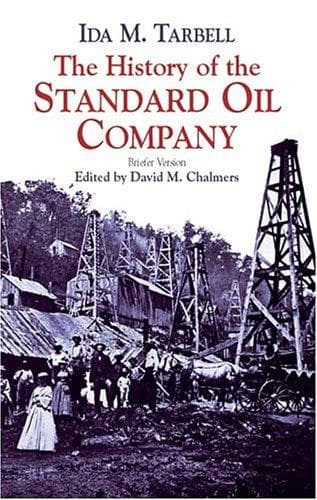
The History of the Standard Oil CompanyTarbell, Ida M. (Ida Minerva)
History
The History of the Standard Oil Company
Tarbell, Ida M. (Ida Minerva)
Petroleum industry and trade -- United States -- History; Standard Oil Company -- History
No doubt the indictment of Mr. Rockefeller in the spring of 1879 seemed
to him the work of malice and spite. By seven years of persistent effort
he had worked out a well-conceived plan for controlling the oil business
of the United States. Another year and he had reason to believe that the
remnant of refiners who still rebelled against his intentions would
either be convinced or dead and he could rule unimpeded. But here at the
very threshold of empire a certain group of people—“people with a
private grievance,” “mossbacks naturally left in the lurch by the
progress of this rapidly developing trade,” his colleagues described
them to the Hepburn Commission—stood in his way. “You have taken
deliberate advantage of the iniquitous practices of the railroads to
build up a monopoly,” they told him. “We combined to overthrow those
practices so far as the oil business was concerned. You not only refused
to support us in this contention, you persuaded or forced the railroads
to make you the only recipient of their illegal favours; more than that,
you developed the unjust practices, forcing them into forms unheard of
before. Not only have you secured rebates of extraordinary value on all
your own shipments, you have persuaded the railroads to give you a
commission on the oil that other people ship. You are guilty of plotting
against the prosperity of an industry.” And they indicted him with eight
of his colleagues for conspiracy.
The evidence on which the oil men based this serious charge has already
been analysed. At the moment they brought their suit for conspiracy what
was their situation? They had several months before driven the
commonwealth of Pennsylvania to bring suits against four railroads
operating within its borders and against the Standard pipe-lines for
infringing their duties as common carriers. Partial testimony had been
taken in the case against the Pennsylvania road and in that against the
United Pipe Lines. These suits, though far from finished, had given the
Producers’ Union the bulk of the proof on which they had secured the
indictment of the Standard officials for conspiracy. Now, since the
railroads and the pipe-lines were the guilty ones—that is, as it was
they who had granted the illegal favours, and as they were the only ones
that could surely be convicted, it seems clear that the only wise course
for the producers would have been to prosecute energetically and
exclusively these first suits. But evident as the necessity for such
persistency was, and just after Mr. Cassatt had startled the public and
given the Union material with which it certainly in time could have
compelled the commonwealth to a complete investigation, the producers
interrupted their work by bringing their spectacular suit for
conspiracy—a suit which perhaps might have been properly instituted
after the others had been completed, but which, introduced now,
completely changed the situation, for it gave the witnesses from whom
Public-domain text, read in full here on John Shaqi.
Reviews
Reviews
No reviews yet
Be the first to share your thoughts on this work.
Elsewhere in the archive
Join the Discussion
Join the discussion
Sign in to leave a comment or review.
Sign InorCreate an account