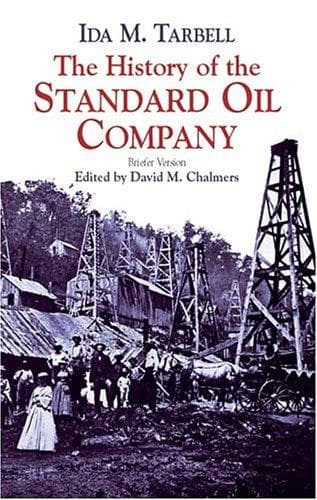
The History of the Standard Oil CompanyTarbell, Ida M. (Ida Minerva)
History
The History of the Standard Oil Company
Tarbell, Ida M. (Ida Minerva)
Petroleum industry and trade -- United States -- History; Standard Oil Company -- History
These negotiations with the Standard continued for a month, and then,
early in February, Mr. Campbell, the president of the Union, called a
meeting of the Grand Council for February 19, 1880, in Titusville,
Pennsylvania. For several weeks the Oil Regions had known that President
Campbell and Roger Sherman, the leading lawyer of the Union, were in
conference with the Standard officials. It was rumoured that they were
arranging a compromise, and it was suspected that the meeting now called
was to consider the terms. Naturally the proposition to be made was
looked for with suspicion and curiosity. The meeting was the largest the
Grand Council had held for many months. It was supposed to be secret,
like all gatherings of the Union, but before the first session was over,
the word spread over the Oil Regions that Mr. Campbell had brought to
the meeting contracts with both Mr. Rockefeller and Mr. Scott, and that
they were receiving harsh criticism from the Grand Council. The very
meagre accounts which exist of this gathering, historic in oil annals,
show that it was one of the most exciting which was ever held in the
country, and one can well believe this when one considers the bitter
pill the council was asked to swallow that day. Mr. Campbell began the
session by reporting that all the suits at which they had been labouring
for nearly two years had been withdrawn, and that in return for their
withdrawal the Standard and the Pennsylvania Railroad officials had
signed contracts to cease certain of the practices of which the
producers complained.
The Standard contract, which Mr. Campbell then presented, pledged Mr.
Rockefeller, and some sixteen associates, whose names were attached to
the document, to the following policy:
1. They would hereafter make no opposition to an entire abrogation of
the system of rebates, drawbacks and secret rates of freight in the
transportation of petroleum on the railroads.
2. They withdrew their opposition to secrecy in rate making—that is,
they promised that they would not hereafter receive any rebate or
drawback that the railroad company was not at liberty to make known and
to give to other shippers of petroleum.
3. They abandoned entirely the policy which they had been pursuing in
the management of the United Pipe Lines—that is, they promised that
there should be no discrimination whatever hereafter between their
patrons; that the rates should be reasonable and not advanced except on
thirty days’ notice; that they would make no difference between the
price of crude in different districts excepting such as might be
properly based upon the difference in the quality of the oil; that they
would receive, transport, store and deliver all oil tendered to them, up
to a production of 65,000 barrels a day. And if the production should
exceed that amount they agreed that they would not purchase any
so-called “immediate shipment” oil at a discount on the price of
certificate oil.
Public-domain text, read in full here on John Shaqi.
Reviews
Reviews
No reviews yet
Be the first to share your thoughts on this work.
Elsewhere in the archive
Join the Discussion
Join the discussion
Sign in to leave a comment or review.
Sign InorCreate an account