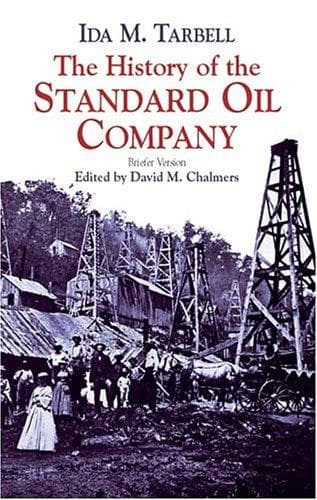
The History of the Standard Oil CompanyTarbell, Ida M. (Ida Minerva)
History
The History of the Standard Oil Company
Tarbell, Ida M. (Ida Minerva)
Petroleum industry and trade -- United States -- History; Standard Oil Company -- History
I do not write this, my friend, with a view of throwing any
discouragement in your path, which, God knows, is rugged and thorny
enough, but I must give vent to my righteous indignation in some
way, and ask you are the producers as a class (nothing but a d—d
cowardly, disorganised mob as they are) worth the efforts you are
putting forth to save them?
As for myself, a single individual (and I can speak for no others),
I am determined to stand with you until the end, with my best
strength and my last dollar.”
Now, what was this loose and easily discouraged organisation opposing? A
compact body of a few able, cold-blooded men—men to whom anything was
right that they could get, men knowing exactly what they wanted, men who
loved the game they played because of the reward at the goal, and, above
all, men who knew how to hold their tongues and wait. “To Mr.
Rockefeller,” they say in the Oil Regions, “a day is as a year and a
year as a day. He can wait, but he never gives up.” Mr. Rockefeller knew
the producers, knew how feeble their staying qualities in anything but
the putting down of oil wells, and he may have said confidently, at the
beginning of their suits against him, as it was reported he did say,
that they would never be finished. They had not been finished from any
lack of material. If the suits had been pushed but one result was
possible, and that was the conviction of both the Standard and the
railroads; they had been left unfinished because of the impatience and
instability of the prosecuting body and the compactness, resolution and
watchfulness of the defendants.
The withdrawal of the suits was a great victory for Mr. Rockefeller.
There was no longer any doubt of his power in defensive operations.
Having won a victory, he quickly went to work to make it secure. The
Union had surrendered, but the men who had made the Union remained; the
evidence against him was piled up in indestructible records. In time the
same elements which had united to form the serious opposition just
overthrown might come together, and if they should it was possible that
they would not a second time make the mistake of vacillation. The press
of the Oil Regions was largely independent. It had lost, to be sure, the
audacity, the wit, the irrepressible spirit of eight years before when
it fought the South Improvement Company. Its discretion had outstripped
its courage, but there were still signs of intelligent independence in
the newspapers. Mr. Rockefeller now entered on a campaign of
reconciliation which aimed to placate, or silence, every opposing force.
Public-domain text, read in full here on John Shaqi.
Reviews
Reviews
No reviews yet
Be the first to share your thoughts on this work.
Elsewhere in the archive
Join the Discussion
Join the discussion
Sign in to leave a comment or review.
Sign InorCreate an account