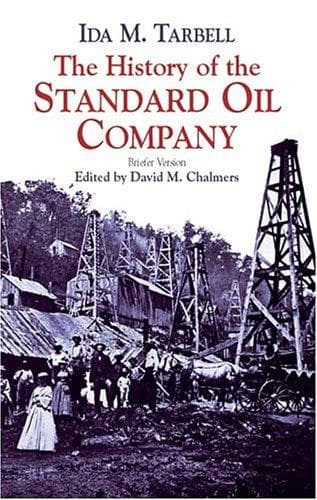
The History of the Standard Oil CompanyTarbell, Ida M. (Ida Minerva)
History
The History of the Standard Oil Company
Tarbell, Ida M. (Ida Minerva)
Petroleum industry and trade -- United States -- History; Standard Oil Company -- History
VI. The party of the second part that it will agree to increase and
lessen the aggregate production of crude petroleum, as the said
joint committee shall direct, to adapt as nearly as practicable the
supply of the same to the capacity of the markets of the world to
absorb at a price remunerative to the producer, the refiner and the
transporter.
VII. The parties hereto mutually, that the said joint committee
shall, at the beginning of each year, fix the minimum average price
at which crude petroleum can be produced and delivered on board
railway cars, which price shall be called the minimum cost of
production—that at the same periods the said committee shall also
fix the minimum average price at which crude oil can be refined, put
up in packages and sold, which price shall be called the minimum
cost of manufacture.
VIII. The parties hereto mutually, that after paying the minimum
cost of production of crude petroleum, the minimum cost of its
manufacture, and the cost of transportation and storage, and
shipping also, in the case of exported oil, the profits shall be
apportioned between the producers and refiners, in the ratio of ...
per cent. to the former, and ... per cent. to the latter.
IX. The said parties, that in case of a temporary over-production of
crude petroleum, the excess shall as far as practicable be taken and
withheld from market, and an advance of three-fourths of the minimum
cost of production advanced thereon by the party of the first part
at eight per cent., intrust the party of the second part keeping the
tanked petroleum insured in good and responsible companies to the
full amount of the advance, one year’s interest added.
X. The said parties mutually, that the party of the first part shall
only be bound to pay the prices and make the advances aforesaid, in
case the producers shall in good faith obey the instructions of the
joint committee, to limit production by stopping the drilling of new
wells.
XI. The party of the second part that it will keep a register of the
date of the commencement of all new wells, the date at which the
same shall be finished, the character of the well and the monthly
production, and the date at which it may be abandoned, and that it
will make it a condition, precedent to the holding of stock in its
company, that the date aforesaid shall be finished by its
stockholders.
XII. Both parties, that it is the especial object of this agreement
to bring the producers and refiners of petroleum into harmony and
co-operation, by reciprocal, fair, and just dealing, for the
promotion of their mutual interests, and everything in this
agreement is to be construed liberally for the carrying into effect
of this object.
NUMBER 11 (See page 1082)
EXTRACTS FROM THE TESTIMONY OF W. G. WARDEN
[From “A History of the Rise and Fall of the South Improvement
Company,” pages 30–41.]
Public-domain text, read in full here on John Shaqi.
Reviews
Reviews
No reviews yet
Be the first to share your thoughts on this work.
Elsewhere in the archive
Join the Discussion
Join the discussion
Sign in to leave a comment or review.
Sign InorCreate an account