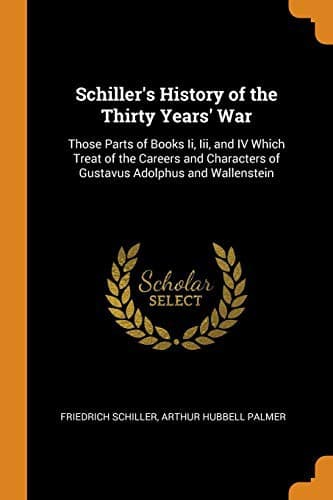
The History of the Thirty Years' WarSchiller, Friedrich
History
The History of the Thirty Years' War
Schiller, Friedrich
Europe -- History -- 1517-1648; Thirty Years' War, 1618-1648
Less fortunate was Pappenheim, the Telamon of the army, the bravest
soldier of Austria and the church. An ardent desire to encounter the
king in person, carried this daring leader into the thickest of the
fight, where he thought his noble opponent was most surely to be met.
Gustavus had also expressed a wish to meet his brave antagonist, but
these hostile wishes remained ungratified; death first brought
together these two great heroes. Two musket-balls pierced the breast of
Pappenheim; and his men forcibly carried him from the field. While they
were conveying him to the rear, a murmur reached him, that he whom he
had sought, lay dead upon the plain. When the truth of the report was
confirmed to him, his look became brighter, his dying eye sparkled with
a last gleam of joy. "Tell the Duke of Friedland," said he, "that I
lie without hope of life, but that I die happy, since I know that the
implacable enemy of my religion has fallen on the same day."
With Pappenheim, the good fortune of the Imperialists departed. The
cavalry of the left wing, already beaten, and only rallied by his
exertions, no sooner missed their victorious leader, than they gave up
everything for lost, and abandoned the field of battle in spiritless
despair. The right wing fell into the same confusion, with the exception
of a few regiments, which the bravery of their colonels Gotz, Terzky,
Colloredo, and Piccolomini, compelled to keep their ground. The Swedish
infantry, with prompt determination, profited by the enemy's confusion.
To fill up the gaps which death had made in the front line, they formed
both lines into one, and with it made the final and decisive charge. A
third time they crossed the trenches, and a third time they captured the
battery. The sun was setting when the two lines closed. The strife grew
hotter as it drew to an end; the last efforts of strength were mutually
exerted, and skill and courage did their utmost to repair in these
precious moments the fortune of the day. It was in vain; despair endows
every one with superhuman strength; no one can conquer, no one will give
way. The art of war seemed to exhaust its powers on one side, only to
unfold some new and untried masterpiece of skill on the other. Night
and darkness at last put an end to the fight, before the fury of the
combatants was exhausted; and the contest only ceased, when no one could
any longer find an antagonist. Both armies separated, as if by tacit
agreement; the trumpets sounded, and each party claiming the victory,
quitted the field.
Public-domain text, read in full here on John Shaqi.
Reviews
Reviews
No reviews yet
Be the first to share your thoughts on this work.
Elsewhere in the archive
Join the Discussion
Join the discussion
Sign in to leave a comment or review.
Sign InorCreate an account