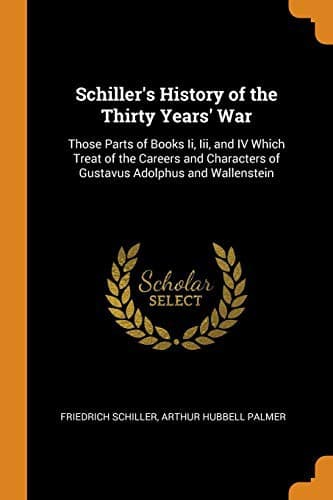
The History of the Thirty Years' WarSchiller, Friedrich
History
The History of the Thirty Years' War
Schiller, Friedrich
Europe -- History -- 1517-1648; Thirty Years' War, 1618-1648
spared him the mortification of seeing his own allies in arms
against him, and all the fruits of his victories torn from him by a
disadvantageous peace. Saxony was already disposed to abandon him,
Denmark viewed his success with alarm and jealousy; and even France, the
firmest and most potent of his allies, terrified at the rapid growth of
his power and the imperious tone which he assumed, looked around at the
very moment he past the Lech, for foreign alliances, in order to check
the progress of the Goths, and restore to Europe the balance of power.
Book IV.
The weak bond of union, by which Gustavus Adolphus contrived to hold
together the Protestant members of the empire, was dissolved by his
death: the allies were now again at liberty, and their alliance, to
last, must be formed anew. By the former event, if unremedied, they
would lose all the advantages they had gained at the cost of so much
bloodshed, and expose themselves to the inevitable danger of becoming
one after the other the prey of an enemy, whom, by their union alone,
they had been able to oppose and to master. Neither Sweden, nor any of
the states of the empire, was singly a match with the Emperor and the
League; and, by seeking a peace under the present state of things, they
would necessarily be obliged to receive laws from the enemy. Union
was, therefore, equally indispensable, either for concluding a peace or
continuing the war. But a peace, sought under the present circumstances,
could not fail to be disadvantageous to the allied powers. With the
death of Gustavus Adolphus, the enemy had formed new hopes; and however
gloomy might be the situation of his affairs after the battle of Lutzen,
still the death of his dreaded rival was an event too disastrous to
the allies, and too favourable for the Emperor, not to justify him in
entertaining the most brilliant expectations, and not to encourage
him to the prosecution of the war. Its inevitable consequence, for the
moment at least, must be want of union among the allies, and what
might not the Emperor and the League gain from such a division of their
enemies? He was not likely to sacrifice such prospects, as the present
turn of affairs held out to him, for any peace, not highly beneficial
to himself; and such a peace the allies would not be disposed to accept.
They naturally determined, therefore, to continue the war, and for this
purpose, the maintenance of the existing union was acknowledged to be
indispensable.
Public-domain text, read in full here on John Shaqi.
Reviews
Reviews
No reviews yet
Be the first to share your thoughts on this work.
Elsewhere in the archive
Join the Discussion
Join the discussion
Sign in to leave a comment or review.
Sign InorCreate an account