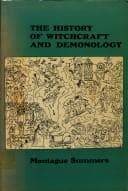
The history of witchcraft and demonologySummers, Montague
History
The history of witchcraft and demonology
Summers, Montague
Demonology; Demonology -- History; Witchcraft; Witchcraft -- History
It is demonstrable, then, that artificial methods of coition, common
in pagan antiquity, have been unblushingly practised throughout all
the ages, as indeed they are at the present day, and that they have
been repeatedly banned and reprobated by the voice of the Church. This
very fact would recommend them to the favour of the Satanists, and
there can be no doubt that amid the dark debaucheries which celebrated
the Sabbats such practice was wellnigh universal. Yet when we sift
the evidence, detailed and exact, of the trials, we find there foul
and hideous mysteries of lust which neither human intercourse nor the
employ of a mechanical property can explain. Howbeit, the theologians
and the inquisitors are fully aware what unspeakable horror lurks in the
blackness beyond.
The animal familiar was quite distinct from the familiar in human shape.
In England particularly there is abundance of evidence concerning them,
and even to-day who pictures a witch with nut-cracker jaws, steeple hat,
red cloak, hobbling along on her crutch, without her big black cat beside
her? It is worth remark that in other countries the domestic animal
familiar is rare, and Bishop Francis Hutchinson even says: “I meet with
little mention of _Imps_ in any Country but ours, where the Law makes
the feeding, suckling, or rewarding of them to be Felony.”[89] Curiously
enough this familiar is most frequently met with in Essex, Suffolk, and
the Eastern counties. We find that animals of all kinds were regarded
as familiars; dogs, cats, ferrets, weasels, toads, rats, mice, birds,
hedgehogs, hares, even wasps, moths, bees, and flies. It is piteous
to think that in many cases some miserable creature who, shunned and
detested by her fellows, has sought friendship in the love of a cat or
a dog, whom she has fondled and lovingly fed with the best tit-bits she
could give, on the strength of this affection alone was dragged to the
gallows or the stake. But very frequently the witch did actually keep
some small animal which she nourished on a diet of milk and bread and
her own blood in order that she might divine by its means. The details
of this particular method of augury are by no means clear. Probably the
witch observed the gait of the animals, its action, the tones of its
voice easily interpreted to bear some fanciful meaning, and no doubt a
dog, or such a bird as a raven, a daw, could be taught tricks to impress
the simplicity of inquirers.
Public-domain text, read in full here on John Shaqi.
Reviews
Reviews
No reviews yet
Be the first to share your thoughts on this work.
Elsewhere in the archive
Join the Discussion
Join the discussion
Sign in to leave a comment or review.
Sign InorCreate an account