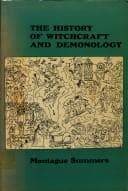
The history of witchcraft and demonologySummers, Montague
History
The history of witchcraft and demonology
Summers, Montague
Demonology; Demonology -- History; Witchcraft; Witchcraft -- History
That Spiritism opens the door to demoniac possession, so often classed
as lunacy, is generally acknowledged by all save the prejudiced and
superstitious. As far back as 1877 Dr. L. S. Forbes Winslow wrote in
_Spiritualistic Madness_: “Ten thousand unfortunate people are at the
present time confined in lunatic asylums on account of having tampered
with the supernatural.” And quoting an American journal he goes on to
say: “Not a week passes in which we do not hear that some of these
unfortunates destroy themselves by suicide, or are removed to a lunatic
asylum. The mediums often manifest signs of an abnormal condition of
their mental faculties, and among certain of them are found unequivocal
indications of a true demoniacal possession. The evil spreads rapidly,
and it will produce in a few years frightful results.... Two French
authors of spiritualistic works, who wrote _Le Monde Spirituel_ and
_Sauvons le genre humain_, died insane in an asylum; these two men were
distinguished in their respective professions; one as a highly scientific
man, the other as an advocate well learned in the Law. These individuals
placed themselves in communication with spirits by means of tables. I
could quote many such instances where men of the highest ability have, so
to speak, neglected all and followed the doctrines of Spiritualism only
to end their days in the lunatic asylum.”
Some half a dozen years ago an inquiry was undertaken and there was
circulated an interrogatory or _enquête_ which invited opinions upon (1)
“the situation as regards the renewed interest in psychic phenomena”;
(2) whether this “psychic renewal” denoted a “passing from a logical and
scientific (deductive) to a spiritual and mystic (inductive) conception
of life,” or “a reconciliation between the two, that is between science
and faith”;[90] (3) “the most powerful argument for, or against, human
survival”; (4) “the best means of organizing this (psychic) movement in
the highest interest, philosophical, religious and scientific, of the
nation, especially as a factor of durable peace.” Five-and-fifty of the
answers were collected and published under the title _Spiritualism: Its
Present-Day Meaning_,[91] a book which certainly makes most interesting
and illuminating if extremely varied reading. Being a symposium, all
schools of thought are represented, and I would venture to add that among
the contributions are some outpourings which evince no thought at all, a
fact which is of itself not without considerable significance. We have
the unflinching logic and sound common-sense of Father Bernard Vaughan,
whose verdict is reiterated by the Rev. James Adderley and the Rev. J.
A. V. Magee; the concise, outspoken, pertinent and telling comments of
General Booth; the vague hopelessly inadequate flotsam of Dr. Percy
Dearmer,[92] vapid stuff which makes a theologian writhe; the sweet
sugary sentimentalism of Miss Evelyn Underhill, so anæmic, so obviously
Public-domain text, read in full here on John Shaqi.
Reviews
Reviews
No reviews yet
Be the first to share your thoughts on this work.
Elsewhere in the archive
Join the Discussion
Join the discussion
Sign in to leave a comment or review.
Sign InorCreate an account