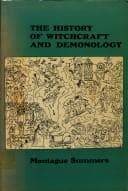
The history of witchcraft and demonologySummers, Montague
History
The history of witchcraft and demonology
Summers, Montague
Demonology; Demonology -- History; Witchcraft; Witchcraft -- History
In his _Theologia Moralis_ he speaks quite precisely when defining the
technical nature of the sin witches commit in commerce with incubi.[42]
[43] This opinion is also that of Martino Bonacina,[44] and of Vincenzo
Filliucci, S.J.[45] “Busembaum has excellently observed that carnal
sins with an evil spirit fall under the head of the technical term
_bestialitas_.”[46] This is also the conclusion of Thomas Tamburini,
S.J. (1591-1675); Benjamin Elbel, O.F.M. (1690-1756);[47] Cardinal
Cajetan, O.P. (1469-1534) “the lamp of the Church”; Juan Azor, S.J.
(1535-1603); “in wisdom, in depth of learning and in gravity of judgement
taking deservedly high rank among theologians” (Gury); and many other
authorities.[48] What a penitent should say in confession is considered
by Monsignor Craisson, sometime Rector of the Grand Seminary of Valence
and Vicar-General of the diocese, in his Tractate _De Rebus Uenereis ad
usum Confessariorum_.[49] Jean-Baptiste Bouvier (1783-1854) the famous
bishop of Le Mans, in his _Dissertatio in Sextum Decalogi Præceptum_[50]
(p. 78) writes: “All theologians speak of ... evil spirits who appear in
the shape of a man, a woman, or even some animal. This is either a real
and actual presence, or the effect of imagination. They decide that this
sin ... incurs particular guilt which must be specifically confessed,
to wit an evil superstition whereof the essence is a compact with the
Devil. In this sin, therefore, we have two distinct kinds of malice, one
an offence against chastity; the other against our holy faith.”[51] Dom
Dominic Schram,[52] O.S.B., in his _Institutiones Theologiæ Mysticæ_
poses the following: “The inquiry is made whether a demon ... may thus
attack a man or woman, whose obsession would be suffered if the subject
were wholly bent upon obtaining perfection and walking the highest paths
of contemplation. Here we must distinguish the true and the false. It is
certain that—whatever doubters may say—there exist such demons, incubi
and succubi: and S. Augustine asserts (_The City of God_, Book XV,
chapter 23) that it is most rash to advance the contrary.... S. Thomas,
and most other theologians maintain this too. Wherefore the men or women
who suffer these impudicities are sinners who either invite demons ...
or who freely consent to demons when the evil spirits tempt them to
commit such abominations. That these and other abandoned wretches may be
violently assaulted by the demon we cannot doubt ... and I myself have
known several persons who although they were greatly troubled on account
of their crimes, and utterly loathed this foul intercourse with the
demon, were nevertheless compelled sorely against their will to endure
these assaults of Satan.”[53]
Public-domain text, read in full here on John Shaqi.
Reviews
Reviews
No reviews yet
Be the first to share your thoughts on this work.
Elsewhere in the archive
Join the Discussion
Join the discussion
Sign in to leave a comment or review.
Sign InorCreate an account