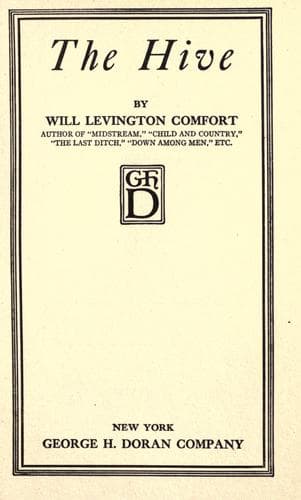
American essays -- 20th century; Child development; Children; Education
There was a man who had found much of beauty and power, much of the
Burning Desert and certain wonderful touches of the peace of the Hill
Country--in his story with a certain woman. She loved him in a way more
real than he dreamed. Life had shown him much to scoff at. He had been
glad to make the most, merely, of an exquisite playwoman. One day she
was down town to meet him, but he left her for a business appointment.
That afternoon, about everything he had in a material way was swept
from him--much to which his ambition had tied itself for several
years. The man was badly rocked. He walked the streets--shocked almost
to laughter, to find all that he had held for, and held to, plucked
from under.... At length he thought of the woman who waited. The
laugh of mockery quickened, because he thought of losing her, too--a
worldly-heart who would go with the rest--goods that perish.
He knocked at the door where she waited. It was opened swiftly. He
did not need to speak.... She seemed above and around him. There was
a great still sweetness he had never dreamed of as a man (and could
only remember dimly as a child to his mother), arms of tenderness
and healing.... He saw that instant in her eyes that nothing of the
world ever did nor ever could really separate them. The queerest thing
about it all was, that he used a word he never could use before--a
word, as he said, that had been so badly worked by the world that it
needed a lot of washing before it was fit for him. Yet it came to his
lips--_wife_--in a way that showed him also a new meaning to the word
_forever_.
* * * * *
This subject of love and mating is only opened. There is much to say
in pages that follow, but now, apropos of nothing, if not this theme,
there is a chapter of letters. They somehow contain the spirit of many
things I have longed to express. Those to whom they appeal will find
the last pages of the book richer because of the insert.
* * * * *
24
CHAPTER OF LETTERS
I
We come up through many slaveries into freedom. It is the end of a
considerable road to be able to stand against the morning sun, saying:
"I want nothing but to give----" ... To be able to say this without an
answering laugh of mockery in the heart, where old King Desire sits
with his dogs.
To be free--that is to be irresistible. Do you want love? You only
spoil it when you stipulate what the return shall be--how the
proffering of the return shall be ordered and arranged. The great love
is giving; great love is incandescence. One must be radiant to be
happy. It is so literally. It is so, fold within fold....
One sees gold, looking up from below, and its attraction becomes
eminent among all desires for the time. We pass it by and look down, as
the spirit of man should look down upon gold, and it becomes a mineral
merely. You can enjoy it as you enjoy other people's roses. It bestows
itself. Others seek to bestow it upon you.
Public-domain text, read in full here on John Shaqi.
Reviews
Reviews
No reviews yet
Be the first to share your thoughts on this work.
Elsewhere in the archive
Join the Discussion
Join the discussion
Sign in to leave a comment or review.
Sign InorCreate an account