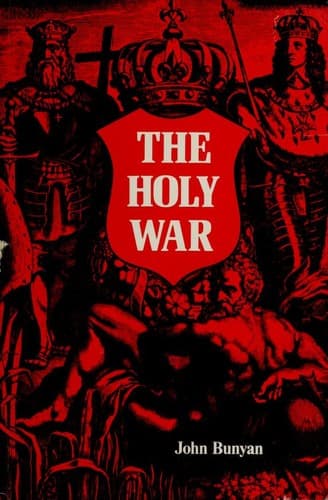
The Holy War, Made by King Shaddai Upon Diabolus, for the Regaining of the Metropolis of the World; Or, The Losing and Taking Again of the Town of MansoulBunyan, John
ReligionChristian
The Holy War, Made by King Shaddai Upon Diabolus, for the Regaining of the Metropolis of the World; Or, The Losing and Taking Again of the Town of Mansoul
Bunyan, John
Christian fiction; Soul; Spiritual warfare -- Fiction
Then said Incredulity, ‘I know not Shaddai; I love my old prince; I
thought it my duty to be true to my trust, and to do what I could to
possess the minds of the men of Mansoul to do their utmost to resist
strangers and foreigners, and with might to fight against them. Nor have
I, nor shall I, change mine opinion for fear of trouble, though you at
present are possessed of place and power.’
Then said the Court, ‘The man, as you see, is incorrigible; he is for
maintaining his villainies by stoutness of words, and his rebellion with
impudent confidence; and therefore set him by, gaoler, and set Mr.
Forget-Good to the bar.
Forget-Good set to the bar.
_Clerk_. Mr. Forget-Good, thou art here indicted by the name of
Forget-Good, (an intruder upon the town of Mansoul,) for that thou, when
the whole affairs of the town of Mansoul were in thy hand, didst utterly
forget to serve them in what was good, and didst fall in with the tyrant
Diabolus against Shaddai the King, against his captains, and all his
host, to the dishonour of Shaddai, the breach of his law, and the
endangering of the destruction of the famous town of Mansoul. What
sayest thou to this indictment? Art thou guilty or not guilty?
Then said Forget-Good: ‘Gentlemen, and at this time my judges, as to the
indictment by which I stand of several crimes accused before you, pray
attribute my forgetfulness to mine age, and not to my wilfulness; to the
craziness of my brain, and not to the carelessness of my mind; and then I
hope I may be by your charity excused from great punishment, though I be
guilty.’
Then said the Court, ‘Forget-Good, Forget-Good, thy forgetfulness of good
was not simply of frailty, but of purpose, and for that thou didst loathe
to keep virtuous things in thy mind. What was bad thou couldst retain,
but what was good thou couldst not abide to think of; thy age, therefore,
and thy pretended craziness, thou makest use of to blind the court
withal, and as a cloak to cover thy knavery. But let us hear what the
witnesses have to say for the King against the prisoner at the bar. Is
he guilty of this indictment, or not?’
_Hate_. My lord, I have heard this Forget-Good say, that he could never
abide to think of goodness, no, not for a quarter of an hour.
_Clerk_. Where did you hear him say so?
_Hate_. In All-base Lane, at a house next door to the sign of the
Conscience seared with a hot iron.
_Clerk_. Mr. Know-All, what can you say for our Lord the King against
the prisoner at the bar?
_Know_. My lord, I know this man well. He is a Diabolonian, the son of
a Diabolonian: his father’s name was Love-Naught; and for him, I have
often heard him say, that he counted the very thoughts of goodness the
most burdensome thing in the world.
_Clerk_. Where have you heard him say these words?
_Know_. In Flesh Lane, right opposite to the church.
Public-domain text, read in full here on John Shaqi.
Reviews
Reviews
No reviews yet
Be the first to share your thoughts on this work.
Elsewhere in the archive
Join the Discussion
Join the discussion
Sign in to leave a comment or review.
Sign InorCreate an account