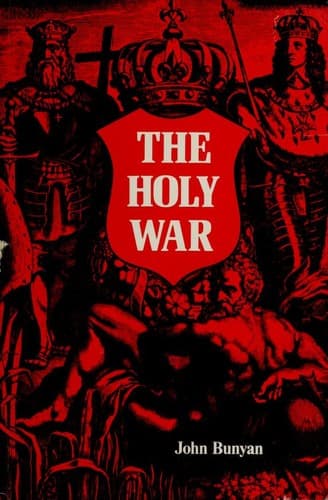
The Holy War, Made by King Shaddai Upon Diabolus, for the Regaining of the Metropolis of the World; Or, The Losing and Taking Again of the Town of MansoulBunyan, John
ReligionChristian
The Holy War, Made by King Shaddai Upon Diabolus, for the Regaining of the Metropolis of the World; Or, The Losing and Taking Again of the Town of Mansoul
Bunyan, John
Christian fiction; Soul; Spiritual warfare -- Fiction
Now when the men of the town saw the multitude of the soldiers that were
come up against the place, and the rams and slings, and the mounts on
which they were planted, together with the glittering of the armour and
the waving of their colours, they were forced to shift, and shift, and
again to shift their thoughts; but they hardly changed for thoughts more
stout, but rather for thoughts more faint; for though before they thought
themselves sufficiently guarded, yet now they began to think that no man
knew what would be their hap or lot.
When the good Prince Emmanuel had thus beleaguered Mansoul, in the first
place he hangs out the white flag, which he caused to be set up among the
golden slings that were planted upon Mount Gracious. And this he did for
two reasons: 1. To give notice to Mansoul that he could and would yet be
gracious if they turned to him. 2. And that he might leave them the more
without excuse, should he destroy them, they continuing in their
rebellion.
So the white flag, with the three golden doves in it, was hung out for
two days together, to give them time and space to consider; but they, as
was hinted before, as if they were unconcerned, made no reply to the
favourable signal of the Prince.
Then he commanded, and they set the red flag upon that mount called Mount
Justice. It was the red flag of Captain Judgment, whose scutcheon was
the burning fiery furnace; and this also stood waving before them in the
wind for several days together. But look how they carried it under the
white flag, when that was hung out, so did they also when the red one
was; and yet he took no advantage of them.
Then he commanded again that his servants should hang out the black flag
of defiance against them, whose scutcheon was the three burning
thunderbolts; but as unconcerned was Mansoul at this as at those that
went before. But when the Prince saw that neither mercy nor judgment,
nor execution of judgment, would or could come near the heart of Mansoul,
he was touched with much compunction, and said, ‘Surely this strange
carriage of the town of Mansoul doth rather arise from ignorance of the
manner and feats of war, than from a secret defiance of us, and
abhorrence of their own lives; or if they know the manner of the war of
their own, yet not the rites and ceremonies of the wars in which we are
concerned, when I make wars upon mine enemy Diabolus.’
Therefore he sent to the town of Mansoul, to let them know what he meant
by those signs and ceremonies of the flag; and also to know of them which
of the things they would choose, whether grace and mercy, or judgment and
the execution of judgment. All this while they kept their gates shut
with locks, bolts, and bars, as fast as they could. Their guards also
were doubled, and their watch made as strong as they could. Diabolus
also did pluck up what heart he could, to encourage the town to make
resistance.
Public-domain text, read in full here on John Shaqi.
Reviews
Reviews
No reviews yet
Be the first to share your thoughts on this work.
Elsewhere in the archive
Join the Discussion
Join the discussion
Sign in to leave a comment or review.
Sign InorCreate an account