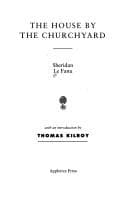
The House by the Church-YardLe Fanu, Joseph Sheridan
General
The House by the Church-Yard
Le Fanu, Joseph Sheridan
Country life -- Ireland -- Fiction; Ireland -- Social life and customs -- 18th century -- Fiction
I'm sure she believed every word she related, for old Sally was
veracious. But all this was worth just so much as such talk commonly
is--marvels, fabulae, what our ancestors called winter's tales--which
gathered details from every narrator, and dilated in the act of
narration. Still it was not quite for nothing that the house was held to
be haunted. Under all this smoke there smouldered just a little spark of
truth--an authenticated mystery, for the solution of which some of my
readers may possibly suggest a theory, though I confess I can't.
Miss Rebecca Chattesworth, in a letter dated late in the autumn of 1753,
gives a minute and curious relation of occurrences in the Tiled House,
which, it is plain, although at starting she protests against all such
fooleries, she has heard with a peculiar sort of interest, and relates
it certainly with an awful sort of particularity.
I was for printing the entire letter, which is really very singular as
well as characteristic. But my publisher meets me with his _veto_; and I
believe he is right. The worthy old lady's letter _is_, perhaps, too
long; and I must rest content with a few hungry notes of its tenor.
That year, and somewhere about the 24th October, there broke out a
strange dispute between Mr. Alderman Harper, of High Street, Dublin, and
my Lord Castlemallard, who, in virtue of his cousinship to the young
heir's mother, had undertaken for him the management of the tiny estate
on which the Tiled or Tyled House--for I find it spelt both ways--stood.
This Alderman Harper had agreed for a lease of the house for his
daughter, who was married to a gentleman named Prosser. He furnished it,
and put up hangings, and otherwise went to considerable expense. Mr. and
Mrs. Prosser came there sometime in June, and after having parted with a
good many servants in the interval, she made up her mind that she could
not live in the house, and her father waited on Lord Castlemallard, and
told him plainly that he would not take out the lease because the house
was subjected to annoyances which he could not explain. In plain terms,
he said it was haunted, and that no servants would live there more than
a few weeks, and that after what his son-in-law's family had suffered
there, not only should he be excused from taking a lease of it, but that
the house itself ought to be pulled down as a nuisance and the habitual
haunt of something worse than human malefactors.
Lord Castlemallard filed a bill in the Equity side of the Exchequer to
compel Mr. Alderman Harper to perform his contract, by taking out the
lease. But the Alderman drew an answer, supported by no less than seven
long affidavits, copies of all which were furnished to his lordship, and
with the desired effect; for rather than compel him to place them upon
the file of the court, his lordship struck, and consented to release
him.
Public-domain text, read in full here on John Shaqi.
Reviews
Reviews
No reviews yet
Be the first to share your thoughts on this work.
Elsewhere in the archive
Join the Discussion
Join the discussion
Sign in to leave a comment or review.
Sign InorCreate an account