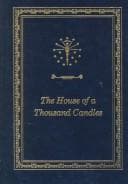
The House of a Thousand CandlesNicholson, Meredith
General
The House of a Thousand Candles
Nicholson, Meredith
Indiana -- Fiction; Inheritance and succession -- Fiction; Mystery and detective stories
After luncheon I went below and directly to the end
of the corridor, and began to sound the walls. To the
eye they were all alike, being of cement, and substantial
enough. Through the area window I saw the solid earth
and snow; surely there was little here to base hope upon,
and my wonder grew at the ease with which Morgan
had vanished through a barred window and into frozen
ground.
The walls at the end of the passage were as solid as
rock, and they responded dully to the stroke of the
hammer. I sounded them on both sides, retracing my
steps to the stairway, becoming more and more impatient
at my ill-luck or stupidity. There was every reason
why I should know my own house, and yet a stranger
and an outlaw ran through it with amazing daring.
After an hour’s idle search I returned to the end of
the corridor, repeated all my previous soundings, and,
I fear, indulged in language unbecoming a gentleman.
Then, in my blind anger, I found what patient search
had not disclosed.
I threw the hammer from me in a fit of temper; it
struck upon a large square in the cement floor which
gave forth a hollow sound. I was on my knees in an
instant, my fingers searching the cracks, and drawing
down close I could feel a current of air, slight but unmistakable,
against my face.
The cement square, though exactly like the others in
the cellar floor, was evidently only a wooden imitation,
covering an opening beneath.
The block was fitted into its place with a nicety that
certified to the skill of the hand that had adjusted it.
I broke a blade of my pocket-knife trying to pry it
up, but in a moment I succeeded, and found it to be
in reality a trap-door, hinged to the substantial part
of the floor.
A current of cool fresh air, the same that had surprised
me in the night, struck my face as I lay flat and
peered into the opening. The lower passage was as black
as pitch, and I lighted a lantern I had brought with me,
found that wooden steps gave safe conduct below and
went down.
I stood erect in the passage and had several inches
to spare. It extended both ways, running back under
the foundations of the house. This lower passage cut
squarely under the park before the house and toward
the school wall. No wonder my grandfather had
brought foreign laborers who could speak no English
to work on his house! There was something delightful
in the largeness of his scheme, and I hurried through
the tunnel with a hundred questions tormenting my
brain.
The air grew steadily fresher, until, after I had gone
about two hundred yards, I reached a point where the
wind seemed to beat down on me from above. I put
up my hands and found two openings about two yards
apart, through which the air sucked steadily. I moved
out of the current with a chuckle in my throat and a
grin on my face. I had passed under the gate in the
school-wall, and I knew now why the piers that held it
had been built so high,—they were hollow and were the
means of sending fresh air into the tunnel.
Public-domain text, read in full here on John Shaqi.
Reviews
Reviews
No reviews yet
Be the first to share your thoughts on this work.
Elsewhere in the archive
Join the Discussion
Join the discussion
Sign in to leave a comment or review.
Sign InorCreate an account