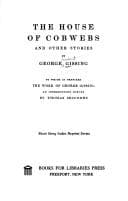
The House of Cobwebs and Other StoriesGissing, George
General
The House of Cobwebs and Other Stories
Gissing, George
Great Britain -- Social life and customs -- 19th century -- Fiction; Short stories
Whose the fault? Towards dawn she argued it with the bitterness of misery.
What a life was hers in this little world of choking respectabilities!
Forbidden this, forbidden that; permitted--the pride of ladyhood. And she
was not a lady, after all. What lady would have permitted herself to
exchange names and addresses with a strange man in a railway
carriage--furtively, too, escaping her father's observation? If not a lady,
what _was_ she? It meant the utter failure of her breeding and education.
The sole end for which she had lived was frustrate. A common, vulgar young
woman--well mated, doubtless, with an impudent clerk, whose noisy talk was
of beer and tobacco!
This arrested her. Stung to the defence of her friend, who, clerk though he
might be, was neither impudent nor vulgar, she found herself driven back
upon self-respect. The battle went on for hours; it exhausted her; it undid
all the good effects of sun and sea, and left her flaccid, pale.
'I'm afraid the journey yesterday was too much for you,' remarked Mr.
Whiston, after observing her as she sat mute the next evening.
'I shall soon recover,' Rose answered coldly.
The father meditated with some uneasiness. He had not forgotten Rose's
singular expression of opinion after their dinner at the inn. His affection
made him sensitive to changes in the girl's demeanour. Next summer they
must really find a more bracing resort. Yes, yes; clearly Rose needed
bracing. But she was always better when the cool days came round.
On the morrow it was his daughter's turn to feel anxious. Mr. Whiston all
at once wore a face of indignant severity. He was absent-minded; he sat at
table with scarce a word; he had little nervous movements, and subdued
mutterings as of wrath. This continued on a second day, and Rose began to
suffer an intolerable agitation. She could not help connecting her father's
strange behaviour with the secret which tormented her heart.
Had something happened? Had her friend seen Mr. Whiston, or written to him?
She had awaited with tremors every arrival of the post. It was
probable--more than probable--that _he_ would write to her; but as yet no
letter came. A week passed, and no letter came. Her father was himself
again; plainly she had mistaken the cause of his perturbation. Ten days,
and no letter came.
It was Saturday afternoon. Mr. Whiston reached home at tea-time. The first
glance showed his daughter that trouble and anger once more beset him. She
trembled, and all but wept, for suspense had overwrought her nerves.
'I find myself obliged to speak to you on a very disagreeable
subject'--thus began Mr. Whiston over the tea-cups--'a very unpleasant
subject indeed. My one consolation is that it will probably settle a little
argument we had down at the seaside.'
As his habit was when expressing grave opinions (and Mr. Whiston seldom
expressed any other), he made a long pause and ran his fingers through his
thin beard. The delay irritated Rose to the last point of endurance.
Public-domain text, read in full here on John Shaqi.
Reviews
Reviews
No reviews yet
Be the first to share your thoughts on this work.
Elsewhere in the archive
Join the Discussion
Join the discussion
Sign in to leave a comment or review.
Sign InorCreate an account