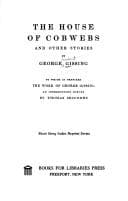
The House of Cobwebs and Other StoriesGissing, George
General
The House of Cobwebs and Other Stories
Gissing, George
Great Britain -- Social life and customs -- 19th century -- Fiction; Short stories
'My dear, you astound me! Is it respectful to force one's acquaintance upon
an unwilling stranger? I really don't understand you. Where is your sense
of propriety, Rose? A vulgar, noisy fellow, who talks of beer and
tobacco--a petty clerk! And he has the audacity to write to me that he
wants to--to make friends with my daughter! Respectful? Honest? Really!'
When Mr. Whiston became sufficiently agitated to lose his decorous gravity,
he began to splutter, and at such moments he was not impressive. Rose kept
her eyes cast down. She felt her strength once more, the strength of a
wholly reasonable and half-passionate revolt against that tyrannous
propriety which Mr. Whiston worshipped.
'Father--'
'Well, my dear?'
'There is only one thing I dislike in these letters--and that is a
falsehood.'
'I don't understand.'
Rose was flushing. Her nerves grew tense; she had wrought herself to a
simple audacity which overcame small embarrassments.
'Mr. Burroughs says that he followed us home from Paddington to discover
our address. That is not true. He asked me for my name and address in the
train, and gave me his.'
The father gasped.
'He _asked_--? You _gave_--?'
'It was whilst you were away in the refreshment-room,' proceeded the girl,
with singular self-control, in a voice almost matter-of-fact. 'I ought to
tell you, at the same time, that it was Mr. Burroughs who brought me the
flowers from the inn, when I forgot them. You didn't see him give them to
me in the station.'
The father stared.
'But, Rose, what does all this mean? You--you overwhelm me! Go on, please.
What next?'
'Nothing, father.'
And of a sudden the girl was so beset with confusing emotions that she
hurriedly quitted her chair and vanished from the room.
Before Mr. Whiston returned to his geographical drawing on Monday morning,
he had held long conversations with Rose, and still longer with himself.
Not easily could he perceive the justice of his daughter's quarrel with
propriety; many days were to pass, indeed, before he would consent to do
more than make inquiries about Charles James Burroughs, and to permit that
aggressive young man to give a fuller account of himself in writing. It was
by silence that Rose prevailed. Having defended herself against the charge
of immodesty, she declined to urge her own inclination or the rights of Mr.
Burroughs; her mute patience did not lack its effect with the scrupulous
but tender parent.
'I am willing to admit, my dear,' said Mr. Whiston one evening, _à propos_
of nothing at all, 'that the falsehood in that young man's letter gave
proof of a certain delicacy.'
'Thank you, father,' replied Rose, very quietly and simply.
It was next morning that the father posted a formal, proper,
self-respecting note of invitation, which bore results.
A POOR GENTLEMAN
It was in the drawing-room, after dinner. Mrs. Charman, the large and
kindly hostess, sank into a chair beside her little friend Mrs. Loring, and
sighed a question.
Public-domain text, read in full here on John Shaqi.
Reviews
Reviews
No reviews yet
Be the first to share your thoughts on this work.
Elsewhere in the archive
Join the Discussion
Join the discussion
Sign in to leave a comment or review.
Sign InorCreate an account