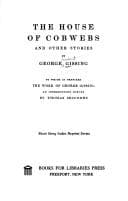
The House of Cobwebs and Other StoriesGissing, George
General
The House of Cobwebs and Other Stories
Gissing, George
Great Britain -- Social life and customs -- 19th century -- Fiction; Short stories
'Yes. I was going to ask you, Mr. Turpin, whether you could do them this
evening. Then I should have them for Monday morning.'
Turpin hesitated, shuffled his feet, and seemed to reflect uneasily; but he
said at length that he 'would see about it,' and, with a rough bow, got out
of the room. That night no hilarious sounds came from the kitchen. On
Sunday morning, when Miss Rodney went into her sitting-room, she found on
the table the wooden geometrical forms, excellently made, just as she
wished. Mabel, who came with breakfast, was bidden to thank her father, and
to say that Miss Rodney would like to speak with him again, if his leisure
allowed, after tea-time on Monday. At that hour the carpenter did not fail
to present himself, distrustful still, but less embarrassed. Miss Rodney
praised his work, and desired to pay for it. Oh! that wasn't worth talking
about, said Turpin; but the lady insisted, and money changed hands. This
piece of business transacted, Miss Rodney produced a Euclid, and asked
Turpin to show her how far he had gone in it with his boy Harry. The
subject proved fruitful of conversation. It became evident that the
carpenter had a mathematical bias, and could be readily interested in such
things as geometrical problems. Why should he not take up the subject
again?
'Nay, miss,' replied Turpin, speaking at length quite naturally; 'I
shouldn't have the heart. If my Harry had lived'
But Miss Rodney stuck to the point, and succeeded in making him promise
that he would get out the old Euclid and have a look at it in his leisure
time. As he withdrew, the man had a pleasant smile on his honest face.
On the next Saturday evening the house was again quiet.
Meanwhile, relations between Mrs. Turpin and her lodger were becoming less
strained. For the first time in her life the flabby, foolish woman had to
do with a person of firm will and bright intelligence; not being vicious of
temper, she necessarily felt herself submitting to domination, and darkly
surmised that the rule might in some way be for her good. All the sluggard
and the slattern in her, all the obstinacy of lifelong habits, hung back
from the new things which Miss Rodney was forcing upon her acceptance, but
she was no longer moved by active resentment. To be told that she cooked
badly had long ceased to be an insult, and was becoming merely a worrying
truism. That she lived in dirt there seemed no way of denying, and though
every muscle groaned, she began to look upon the physical exertion of
dusting and scrubbing as part of her lot in life. Why she submitted, Mrs.
Turpin could not have told you. And, as was presently to be seen, there
were regions of her mind still unconquered, instincts of resistance which
yet had to come into play.
Public-domain text, read in full here on John Shaqi.
Reviews
Reviews
No reviews yet
Be the first to share your thoughts on this work.
Elsewhere in the archive
Join the Discussion
Join the discussion
Sign in to leave a comment or review.
Sign InorCreate an account