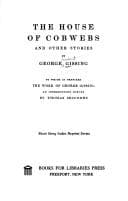
The House of Cobwebs and Other StoriesGissing, George
General
The House of Cobwebs and Other Stories
Gissing, George
Great Britain -- Social life and customs -- 19th century -- Fiction; Short stories
Firmness was not the most legible characteristic of Miss Shepperson's
physiognomy. A plain woman of something more than thirty, she had gentle
eyes, a twitching forehead, and lips ever ready for a sympathetic smile.
Her attire, a little shabby, a little disorderly, well became the occupant
of furnished lodgings, at twelve and sixpence a week, in the unpretentious
suburb of Acton. She was the daughter of a Hammersmith draper, at whose
death, a few years ago, she had become possessed of a small house and an
income of forty pounds a year; her two elder sisters were comfortably
married to London tradesmen, but she did not see very much of them, for
their ways were not hers, and Miss Shepperson had always been one of those
singular persons who shrink into solitude the moment they feel ill at ease.
The house which was her property had, until of late, given her no trouble
at all; it stood in a quiet part of Hammersmith, and had long been occupied
by good tenants, who paid their rent (fifty pounds) with exemplary
punctuality; repairs, of course, would now and then be called for, and to
that end Miss Shepperson carefully put aside a few pounds every year.
Unhappily, the old tenants were at length obliged to change their abode.
The house stood empty for two months; it was then taken on a three years'
lease by a family named Rymer--really nice people, said Miss Shepperson to
herself after her first interview with them. Mr. Rymer was 'in the City';
Mrs. Rymer, who had two little girls, lived only for domestic peace--she
had been in better circumstances, but did not repine, and forgot all
worldly ambition in the happy discharge of her wifely and maternal duties.
'A charming family!' was Miss Shepperson's mental comment when, at their
invitation, she had called one Sunday afternoon soon after they were
settled in the house; and, on the way home to her lodgings, she sighed once
or twice, thinking of Mrs. Rymer's blissful smile and the two pretty
children.
The first quarter's rent was duly paid, but the second quarter-day brought
no cheque; and, after the lapse of a fortnight, Miss Shepperson wrote to
make known her ingenuous fear that Mr. Rymer's letter might have
miscarried. At once there came the politest and friendliest reply. Mr.
Rymer (wrote his wife) was out of town, and had been so overwhelmed with
business that the matter of the rent must have altogether escaped his mind;
he would be back in a day or two, and the cheque should be sent at the
earliest possible moment; a thousand apologies for this unpardonable
neglect. Still the cheque did not come; another quarter-day arrived, and
again no rent was paid. It was now a month after Christmas, and Miss
Shepperson, for the first time in her life, found her accounts in serious
disorder. This morning she had a letter from Mrs. Rymer, the latest of a
dozen or so, all in the same strain--
Public-domain text, read in full here on John Shaqi.
Reviews
Reviews
No reviews yet
Be the first to share your thoughts on this work.
Elsewhere in the archive
Join the Discussion
Join the discussion
Sign in to leave a comment or review.
Sign InorCreate an account