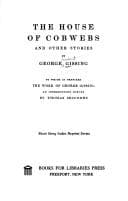
The House of Cobwebs and Other StoriesGissing, George
General
The House of Cobwebs and Other Stories
Gissing, George
Great Britain -- Social life and customs -- 19th century -- Fiction; Short stories
She arrived on Saturday afternoon, and was received by the assembled family
like a very dear friend or relative. Mr. Rymer, a well-dressed man, polite,
good-natured, with a frequent falsetto laugh, talked over the teacups in
the pleasantest way imaginable, not only putting Miss Shepperson at ease,
but making her feel as if her position as a member of the household were
the most natural thing in the world. His mere pronunciation of her name
gave it a dignity, an importance quite new to Miss Shepperson's ears. He
had a way of shaping his remarks so as to make it appear that the homely,
timid woman was, if anything, rather the superior in rank and education,
and that their simple ways might now and then cause her amusement. Even the
children seemed to do their best to make the newcomer feel at home. Cissy,
whose age was nine, assiduously handed toast and cake with a most engaging
smile, and little Minnie, not quite six, deposited her kitten in Miss
Shepperson's lap, saying prettily, 'You may stroke it whenever you like.'
Miss Shepperson, to be sure, had personal qualities which could not but
appeal to people of discernment. Her plain features expressed a simplicity
and gentleness which more than compensated for the lack of conventional
grace in her manners; she spoke softly and with obvious frankness, nor was
there much fault to find with her phrasing and accent; dressed a little
more elegantly, she would in no way have jarred with the tone of average
middle-class society. If she had not much education, she was altogether
free from pretence, and the possession of property (which always works very
decidedly for good or for evil) saved her from that excess of deference
which would have accentuated her social shortcomings. Undistinguished as
she might seem at the first glance, Miss Shepperson could not altogether be
slighted by any one who had been in her presence for a few minutes. And
when, in the course of the evening, she found courage to converse more
freely, giving her views, for instance, on the great servant question, and
on other matters of domestic interest, it became clear to Mr. and Mrs.
Rymer that their landlady, though a soft-hearted and simple-minded woman,
was by no means to be regarded as a person of no account.
The servant question was to the front just now, as Mrs. Rymer explained in
detail. She, 'of course,' kept two domestics, but was temporarily making
shift with only one, it being so difficult to replace the cook, who had
left a week ago. Did Miss Shepperson know of a cook, a sensible,
trustworthy woman? For the present Mrs. Rymer--she confessed it with a
pleasant little laugh--had to give an eye to the dinner herself.
Public-domain text, read in full here on John Shaqi.
Reviews
Reviews
No reviews yet
Be the first to share your thoughts on this work.
Elsewhere in the archive
Join the Discussion
Join the discussion
Sign in to leave a comment or review.
Sign InorCreate an account