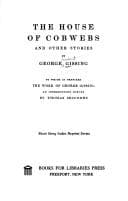
The House of Cobwebs and Other StoriesGissing, George
General
The House of Cobwebs and Other Stories
Gissing, George
Great Britain -- Social life and customs -- 19th century -- Fiction; Short stories
Miss Shepperson found it impossible to speak as she wished, and before the
conversation came to an end she saw the matter entirely from her friend's
point of view. She had, in truth, no immediate need of money, and the more
she thought of it, the more content she was to do a kindness to the Rymers,
while at the same time benefiting herself. That very evening Mr. Rymer
prepared a legal document, promising to pay on demand the sum which became
due to Miss Shepperson to-morrow, with compound interest at the rate of
four per cent. While signing this, he gravely expressed his conviction that
before Michaelmas the time for payment would have arrived.
'But if it were next week,' he added, with a polite movement towards his
creditor, 'I should be not a bit the less grateful to our most kind
friend.'
'Oh, but it's purely a matter of business,' said Miss Shepperson, who was
always abashed by such expressions.
'To be sure,' murmured Mrs. Rymer. 'Let us look at it in that light. But it
shan't prevent us from calling Miss Shepperson our dearest friend.'
The homely woman blushed and felt happy.
Towards the end of autumn, when the domestic crisis was very near, the
servant declared herself ill, and at twenty-four hours' notice quitted the
house. As a matter of fact, she had received no wages for several months;
the kindness with which she was otherwise treated had kept her at her post
thus long, but she feared the increase of work impending, and preferred to
go off unpaid. Now for the first time did Mrs. Rymer's nerves give way.
Miss Shepperson found her sobbing by the fireside, the two children
lamenting at such an unwonted spectacle. Where was a new servant to be
found? In a day or two the monthly nurse would be here, and must, of
course, be waited upon. And what was to become of the children? Miss
Shepperson, moved by the calamitous situation, entreated her friend to
leave everything to her. She would find a servant somehow, and meanwhile
would keep the house going with her own hands. Mrs. Rymer sobbed that she
was ashamed to allow such a thing; but the other, braced by a crisis,
displayed wonderful activity and resource. For two days Miss Shepperson did
all the domestic labour; then a maid, of the species known as 'general,'
presented herself, and none too soon, for that same night there was born to
the Rymers a third daughter. But troubles were by no means over. While Mrs.
Rymer was ill--very ill indeed--the new handmaid exhibited a character so
eccentric that, after nearly setting fire to the house while in a state of
intoxication, she had to be got rid of as speedily as possible. Miss
Shepperson resolved that, for the present, there should be no repetition of
such disagreeable things. She quietly told Mr. Rymer that she felt quite
able to grapple with the situation herself.
Public-domain text, read in full here on John Shaqi.
Reviews
Reviews
No reviews yet
Be the first to share your thoughts on this work.
Elsewhere in the archive
Join the Discussion
Join the discussion
Sign in to leave a comment or review.
Sign InorCreate an account