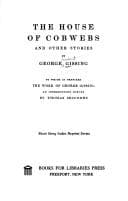
The House of Cobwebs and Other StoriesGissing, George
General
The House of Cobwebs and Other Stories
Gissing, George
Great Britain -- Social life and customs -- 19th century -- Fiction; Short stories
'I was so glad,' said Mrs. Rymer one day to her friend, the day on which
she first rose from bed, 'that my husband took you into his confidence
about our affairs. Now you know everything, and it is much better. You know
that we are very unlucky, but that no one can breathe a word against our
honour. This was the thought that held me up through my illness. In a very
short time all our debts will be paid--every farthing, and it will be
delightful to remember how we struggled, and what we endured, to keep an
honest name. Though,' she added tenderly, 'how we should have done without
_you_, I really cannot imagine. We might have sunk--gone down!'
For months Mrs. Rymer led the life of a feeble convalescent. She ought to
have had change of air, but that was out of the question, for Mr. Rymer's
business was as unremunerative as ever, and with difficulty he provided the
household with food. One gleam of light kept up the courage of the family:
the aged relative was known to be so infirm that he could only leave the
house in a bath-chair; every day there might be news even yet more
promising. Meanwhile, the girl of sixteen exercised her incompetence in the
meaner departments of domestic life, and Miss Shepperson did all the work
that required care or common-sense, the duties of nursemaid alone taking a
great deal of her time. On the whole, this employment seemed to suit her;
she had a look of improved health, enjoyed more equable spirits, and in her
manner showed more self-confidence. Once a month she succeeded in getting a
few hours' holiday, and paid a visit to one or the other of her sisters;
but to neither of them did she tell the truth regarding her position in the
house at Hammersmith. Now and then, when every one else under the roof was
asleep, she took from a locked drawer in her bedroom a little account-book,
and busied herself with figures. This she found an enjoyable moment; it was
very pleasant indeed to make the computation of what the Rymers owed to
her, a daily-growing debt of which the payment could not now be long
delayed. She did not feel quite sure with regard to the interest, but the
principal of the debt was very easily reckoned, and it would make a nice
little sum to put by. Certainly Miss Shepperson was not unhappy.
Mrs. Rymer was just able to resume her normal habits, to write many
letters, teach her children, pay visits in distant parts of London--the
care of the baby being still chiefly left to Miss Shepperson--when, on a
pleasant day of spring, a little before lunch-time, Mr. Rymer rushed into
the house, calling in an agitated voice his wife's name. Miss Shepperson
was the only person at home, for Mrs. Rymer had gone out with the children,
the servant accompanying her to wheel baby's perambulator; she ran up from
the kitchen, aproned, with sleeves rolled to the elbow, and met the excited
man as he descended from a vain search in the bedrooms.
Public-domain text, read in full here on John Shaqi.
Reviews
Reviews
No reviews yet
Be the first to share your thoughts on this work.
Elsewhere in the archive
Join the Discussion
Join the discussion
Sign in to leave a comment or review.
Sign InorCreate an account