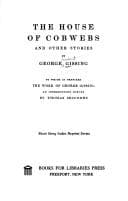
The House of Cobwebs and Other StoriesGissing, George
General
The House of Cobwebs and Other Stories
Gissing, George
Great Britain -- Social life and customs -- 19th century -- Fiction; Short stories
While the Hall, in Sir Henry's time, remained childless, the lodge prided
itself on a boy and two girls. Young Rockett, something of a scapegrace,
was by the baronet's advice sent to sea, and thenceforth gave his parents
no trouble. The second daughter, Betsy, grew up to be her mother's help.
But Betsy's elder sister showed from early years that the life of the lodge
would afford no adequate scope for _her_ ambitions. May Rockett had good
looks; what was more, she had an intellect which sharpened itself on
everything with which it came in contact. The village school could never
have been held responsible for May Rockett's acquirements and views at the
age of ten; nor could the High School in the neighbouring town altogether
account for her mental development at seventeen. Not without misgivings had
the health-broken gardener and his wife consented to May's pursuit of the
higher learning; but Sir Henry and the kind old Lady Shale seemed to think
it the safer course, and evidently there was little chance of the girl's
accepting any humble kind of employment: in one way or another she must
depend for a livelihood upon her brains. At the time of Sir Edwin's
succession Miss Rockett had already obtained a place as governess, giving
her parents to understand that this was only, of course, a temporary
expedient--a paving of the way to something vaguely, but superbly,
independent. Nor was promotion long in coming. At two-and-twenty May
accepted a secretaryship to a lady with a mission--concerning the rights of
womanhood. In letters to her father and mother she spoke much of the
importance of her work, but did not confess how very modest was her salary.
A couple of years went by without her visiting the old home; then, of a
sudden, she made known her intention of coming to stay at the lodge 'for a
week or ten days.' She explained that her purpose was rest; intellectual
strain had begun rather to tell upon her, and a few days of absolute
tranquillity, such as she might expect under the elms of Brent Hall, would
do her all the good in the world. 'Of course,' she added, 'it's unnecessary
to say anything about me to the Shale people. They and I have nothing in
common, and it will be better for us to ignore each other's existence.'
Public-domain text, read in full here on John Shaqi.
Reviews
Reviews
No reviews yet
Be the first to share your thoughts on this work.
Elsewhere in the archive
Join the Discussion
Join the discussion
Sign in to leave a comment or review.
Sign InorCreate an account