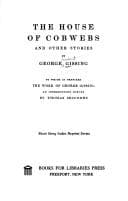
The House of Cobwebs and Other StoriesGissing, George
General
The House of Cobwebs and Other Stories
Gissing, George
Great Britain -- Social life and customs -- 19th century -- Fiction; Short stories
'But,' he inquired, after reflection, 'how was it the man never wrote to
ask why I sent no more work?'
'That asks for further confession. While at the seaside I wrote, in a
disguised hand, a letter supposed to come from a brother of yours in which
I said you were very ill and must cease your correspondence. Starkey hadn't
the decency to reply, but if he had done so I should have got his letter at
the post-office.'
Mr. Wigmore looked troubled for a moment. However, this too was laughed
away, and the pursuit of gentility went on as rigorously as ever.
But Topham, musing over his good luck, thought with a shiver on how small
an accident it had depended. Had Starkey been at home when the fruiterer
called, he, it was plain, would have had the offer of this engagement.
'With the result that dear old Wigmore would have been bled for who knows
how many years by a mere swindler. Whereas he is really being educated,
and, for all I know, may some day adorn the Church of England.' Such
thoughts are very consoling.
A LODGER IN MAZE POND
Harvey Munden had settled himself in a corner of the club smoking-room,
with a cigar and a review. At eleven o'clock on a Saturday morning in
August he might reasonably expect to be undisturbed. But behold, there
entered a bore, a long-faced man with a yellow waistcoat, much dreaded by
all the members; he stood a while at one of the tables, fingering
newspapers and eyeing the solitary. Harvey heard a step, looked up, and
shuddered.
The bore began his attack in form; Harvey parried with as much resolution
as his kindly nature permitted.
'You know that Dr. Shergold is dying?' fell casually from the imperturbable
man.
'Dying?'
Munden was startled into attention, and the full flow of gossip swept about
him. Yes, the great Dr. Shergold lay dying; there were bulletins in the
morning papers; it seemed unlikely that he would see another dawn.
'Who will benefit by his decease?' inquired the bore. 'His nephew, do you
think?'
'Very possibly.'
'A remarkable man, that--a _most_ remarkable man. He was at Lady Teasdale's
the other evening, and he talked a good deal. Upon my word, it reminded one
of Coleridge, or Macaulay,--that kind of thing. Certainly most brilliant
talk. I can't remember what it was all about--something literary. A sort of
fantasia, don't you know. Wonderful eloquence. By the bye, I believe he is
a great friend of yours?'
'Oh, we have known each other for a long time.'
'Somebody was saying that he had gone in for medicine--walking one of the
hospitals--that kind of thing.'
'Yes, he's at Guy's.'
To avoid infinite questioning, Harvey flung aside his review and went to
glance at the _Times_. He read the news concerning the great physician.
Then, as his pursuer drew near again, he hastily departed.
Public-domain text, read in full here on John Shaqi.
Reviews
Reviews
No reviews yet
Be the first to share your thoughts on this work.
Elsewhere in the archive
Join the Discussion
Join the discussion
Sign in to leave a comment or review.
Sign InorCreate an account