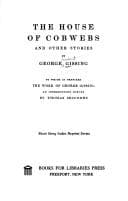
The House of Cobwebs and Other StoriesGissing, George
General
The House of Cobwebs and Other Stories
Gissing, George
Great Britain -- Social life and customs -- 19th century -- Fiction; Short stories
Munden returned her look with a certain curiosity, and watched her as she
began to clink together the things upon the table. Obviously she esteemed
herself a person of some importance. Her figure was not bad, and her
features had the trivial prettiness so commonly seen in London girls of the
lower orders,--the kind of prettiness which ultimately loses itself in fat
and chronic perspiration. Her complexion already began to show a tendency
to muddiness, and when her lips parted, they showed decay of teeth. In
dress she was untidy; her hair exhibited a futile attempt at elaborate
arrangement; she had dirty hands.
Disposed to talk, she lingered as long as possible, but Harvey Munden had
no leanings to this kind of colloquy; when the girl took herself off, he
drew a breath of satisfaction, and smiled the smile of an intellectual man
who has outlived youthful follies.
He stepped over to the lodger's bookcase. There were about a hundred
volumes, only a handful of them connected with medical study. Seeing a
volume of his own Munden took it down and idly turned the pages; it
surprised him to discover a great many marginal notes in pencil, and an
examination of these showed him that Shergold must have gone carefully
through the book with an eye to the correction of its style; adjectives
were deleted and inserted, words of common usage removed for others which
only a fine literary conscience could supply, and in places even the
punctuation was minutely changed. Whilst he still pondered this singular
manifestation of critical zeal, the door opened, and Shergold came in.
A man of two-and-thirty, short, ungraceful, ill-dressed, with features as
little commonplace as can be imagined. He had somewhat a stern look, and on
his brow were furrows of care. Light-blue eyes tended to modify the all but
harshness of his lower face; when he smiled, as on recognising his friend,
they expressed a wonderful innocence and suavity of nature; overshadowed,
in thoughtful or troubled mood, by his heavy eyebrows, they became deeply
pathetic. His nose was short and flat, yet somehow not ignoble; his full
lips, bare of moustache, tended to suggest a melancholy fretfulness. But
for the high forehead, no casual observer would have cared to look at him a
second time; but that upper story made the whole countenance vivid with
intellect, as though a light beamed upon it from above.
'You hypercritical beggar!' cried Harvey, turning with the volume in his
hand. 'Is this how you treat the glorious works of your contemporaries?'
Shergold reddened and was mute.
'I shall take this away with me,' pursued the other, laughing. 'It'll be
worth a little study.'
'My dear fellow--you won't take it ill of me--I didn't really mean it as a
criticism,' the deep, musical voice stammered in serious embarrassment.
'Why, wasn't it just this kind of thing that caused a quarrel between
George Sand and Musset?'
Public-domain text, read in full here on John Shaqi.
Reviews
Reviews
No reviews yet
Be the first to share your thoughts on this work.
Elsewhere in the archive
Join the Discussion
Join the discussion
Sign in to leave a comment or review.
Sign InorCreate an account