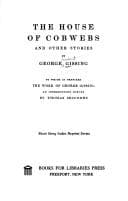
The House of Cobwebs and Other StoriesGissing, George
General
The House of Cobwebs and Other Stories
Gissing, George
Great Britain -- Social life and customs -- 19th century -- Fiction; Short stories
For fifteen years he had walked to and fro over Blackfriars Bridge, leaving
his home in Camberwell at eight o'clock and reaching it again at seven.
Fate made him a commercial clerk as his father before him; he earned more
than enough for his necessities, but seemed to have reached the limit of
promotion, for he had no influential friends, and he lacked the capacity to
rise by his own efforts. There may have been some calling for which Thomas
was exactly suited, but he did not know of it; in the office he proved
himself a trustworthy machine, with no opportunity of becoming anything
else. His parents were dead, his kindred scattered, he lived, as for
several years past, in lodgings. But it never occurred to him to think of
his lot as mournful. A man of sociable instincts, he had many
acquaintances, some of whom he cherished. An extreme simplicity marked his
tastes, and the same characteristic appeared in his conversation; an easy
man to deceive, easy to make fun of, yet impossible to dislike, or
despise--unless by the despicable. He delighted in stories of adventure, of
bravery by flood or field, and might have posed--had he ever posed at
all--as something of an authority on North Pole expeditions and the
geography of Polynesia.
He received his salary once a month, and to-day was pay-day: the
consciousness of having earned a certain number of sovereigns always set
his thoughts on possible purchases, and at present he was revolving the
subject of his wardrobe. Certainly it needed renewal, but Thomas could not
decide at which end to begin, head or feet. His position in a leading house
demanded a good hat, the bad weather called for new boots. Living
economically as he did, it should have been a simple matter to resolve the
doubt by purchasing both articles, but, for one reason and another, Thomas
seldom had a surplus over the expenses of his lodgings; in practice he
found it very difficult to save a sovereign for other needs.
When evening released him he walked away in a cheerful frame of mind,
grasping the money in his trousers' pocket, and all but decided to make
some acquisition on the way home. Near Ludgate Circus some one addressed
him over his shoulder.
'Good evening, Tom; pleasant for the time of year.'
The speaker was a man of fifty, stout and florid--the latter peculiarity
especially marked in his nose; he looked like a substantial merchant, and
spoke with rather pompous geniality. Thrusting his arm through the clerk's,
he walked with him over Blackfriars Bridge, talking in the friendliest
strain of things impersonal. Beyond the bridge--
'Do you tram it?' he asked, glancing upwards.
'I think so, Mr. Warbeck,' answered the other, whose tone to his
acquaintance was very respectful.
Public-domain text, read in full here on John Shaqi.
Reviews
Reviews
No reviews yet
Be the first to share your thoughts on this work.
Elsewhere in the archive
Join the Discussion
Join the discussion
Sign in to leave a comment or review.
Sign InorCreate an account