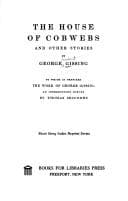
The House of Cobwebs and Other StoriesGissing, George
General
The House of Cobwebs and Other Stories
Gissing, George
Great Britain -- Social life and customs -- 19th century -- Fiction; Short stories
In this room, locked away from all eyes but his own, lay certain relics
which Thomas worshipped. One was a photograph of a girl of fifteen. At that
age Alma Warbeck promised little charm, and the photograph allowed her
less; but it was then that Thomas Bird became her bondman, as he had ever
since remained. There was also a letter, the only one that he had ever
received from her--'Dear Mr. Bird,--Mamma says will you buy her some more
of those _jewjewbs_ at the shop in the city, and bring them on
Sunday.--Yours sincerely, Alma Warbeck'--written when she was sixteen,
seven years ago. Moreover, there was a playbill, used by Alma on the single
occasion when he accompanied the family to a theatre.
Never had he dared to breathe a syllable of what he thought--'hoped' would
misrepresent him, for Thomas in this matter had always stifled hope.
Indeed, hope would have been irrational. In the course of her teens Alma
grew tall and well proportioned; not beautiful of feature, but pleasing;
not brilliant in personality, but good-natured; fairly intelligent and
moderately ambitious. She was the only daughter of a dubiously active
commission-agent, and must deem it good fortune if she married a man with
three or four hundred a year; but Thomas Bird had no more than his twelve
pounds a month, and did not venture to call himself a gentleman. In Alma he
found the essentials of true ladyhood--perhaps with reason; he had never
heard her say an ill-natured thing, nor seen upon her face a look which
pained his acute sensibilities; she was unpretentious, of equal temper,
nothing of a gossip, kindly disposed. Never for a moment had he flattered
himself that Alma perceived his devotion or cared for him otherwise than as
for an old friend. But thought is free, and so is love. The modest clerk
had made this girl the light of his life, and whether far or near the rays
of that ideal would guide him on his unworldly path.
New shaven and freshly clad, he set out for the Warbecks' house, which was
in a near part of Brixton. Not an imposing house by any means, but an
object of reverence to Thomas Bird. A servant whom he did not
recognise--servants came and went at the Warbecks'--admitted him to the
drawing-room, which was vacant; there, his eyes wandering about the
gimcrack furniture, which he never found in the same arrangement at two
successive visits, he waited till his hostess came in.
Mrs. Warbeck was very stout, very plain, and rather untidy, yet her
countenance made an impression not on the whole disagreeable; with her wide
eyes, slightly parted lips, her homely smile, and unadorned speech, she
counteracted in some measure the effect, upon a critical observer, of the
pretentious ugliness with which she was surrounded. Thomas thought her a
straightforward woman, and perhaps was not misled by his partiality.
Certainly the tone in which she now began, and the tenor of her remarks,
repelled suspicion of duplicity.
Public-domain text, read in full here on John Shaqi.
Reviews
Reviews
No reviews yet
Be the first to share your thoughts on this work.
Elsewhere in the archive
Join the Discussion
Join the discussion
Sign in to leave a comment or review.
Sign InorCreate an account