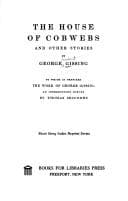
The House of Cobwebs and Other StoriesGissing, George
General
The House of Cobwebs and Other Stories
Gissing, George
Great Britain -- Social life and customs -- 19th century -- Fiction; Short stories
'Well, sir, I'm rather disposed to look at it in that light myself. My
nature is not discontented, Mr. Goldthorpe. But, sir, if you could have
seen me when the lawyer began to explain about the houses! I was absolutely
ignorant of the leasehold system; and at first I really couldn't
understand. The lawyer thought me a fool, I fear, sir. And when I came down
here and saw the houses themselves! I'm afraid, Mr. Goldthorpe, I'm really
afraid, sir, I was weak enough to shed a tear.'
They were sitting by the light of a very small lamp, which did not tend to
cheerfulness.
'Come,' cried Goldthorpe, 'after all, the houses are yours for a
twelvemonth. Why shouldn't we both live on here all the time? It'll be a
little breezy in winter, but we could have the fireplaces knocked into
shape, and keep up good fires. When I've sold my book I'll pay a higher
rent, Mr. Spicer. I like the old house, upon my word I do! Come, let us
have a tune before we go to bed.'
Smiling and happy, Mr. Spicer fetched from the cupboard his concertina, and
after the usual apology for what he called his 'imperfect mastery of the
instrument,' sat down to play 'Home, Sweet Home.' He had played it for
years, and evidently would never improve in his execution. After 'Home,
Sweet Home' came 'The Bluebells of Scotland,' after that 'Annie Laurie';
and Mr. Spicer's repertory was at an end. He talked of learning new pieces,
but there was not the slightest hope of this achievement.
Mr. Spicer's mental development had ceased more than twenty years ago,
when, after extreme efforts, he had attained the qualification of chemist's
assistant. Since then the world had stood still with him. Though a true
lover of books, he knew nothing of any that had been published during his
own lifetime. His father, though very poor, had possessed a little
collection of volumes, the very same which now stood in Mr. Spicer's
cupboard. The authors represented in this library were either English
classics or obscure writers of the early part of the nineteenth century.
Knowing these books very thoroughly, Mr. Spicer sometimes indulged in a
quotation which would have puzzled even the erudite. His favourite poet was
Cowper, whose moral sentiments greatly soothed him. He spoke of Byron like
some contemporary who, whilst admitting his lordship's genius, felt an
abhorrence of his life. He judged literature solely from the moral point of
view, and was incapable of understanding any other. Of fiction he had read
very little indeed, for it was not regarded with favour by his parents.
Scott was hardly more than a name to him. And though he avowed acquaintance
with one or two works of Dickens, he spoke of them with an uneasy smile, as
if in some doubt as to their tendency. With these intellectual
characteristics, Mr. Spicer naturally found it difficult to appreciate the
attitude of his literary friend, a young man whose brain thrilled in
response to modern ideas, and who regarded himself as the destined leader
Public-domain text, read in full here on John Shaqi.
Reviews
Reviews
No reviews yet
Be the first to share your thoughts on this work.
Elsewhere in the archive
Join the Discussion
Join the discussion
Sign in to leave a comment or review.
Sign InorCreate an account