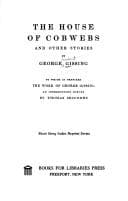
The House of Cobwebs and Other StoriesGissing, George
General
The House of Cobwebs and Other Stories
Gissing, George
Great Britain -- Social life and customs -- 19th century -- Fiction; Short stories
of a new school of fiction. Not indiscreet, Goldthorpe soon became aware
that he had better talk as little as possible of the work which absorbed
his energies. He had enough liberality and sense of humour to understand
and enjoy his landlord's conversation, and the simple goodness of the man
inspired him with no little respect. Thus they got along together
remarkably well. Mr. Spicer never ceased to feel himself honoured by the
presence under his roof of one who--as he was wont to say--wielded the pen.
The tradition of Grub Street was for him a living fact. He thought of all
authors as struggling with poverty, and continued to cite
eighteenth-century examples by way of encouraging Goldthorpe and animating
his zeal. Whilst the young man was at work Mr. Spicer moved about the house
with soundless footsteps. When invited into his tenant's room he had a
reverential demeanour, and the sight of manuscript on the bare deal table
caused him to subdue his voice.
The weeks went by, and Goldthorpe's novel steadily progressed. In London he
had only two or three acquaintances, and from them he held aloof, lest
necessity or temptation should lead to his spending money which he could
not spare. The few letters which he received were addressed to a
post-office--impossible to shock the nerves of a postman by requesting him
to deliver correspondence at this dead house, of which the front door had
not been opened for years. The weather was perfect; a great deal of
sunshine, but as yet no oppressive heat, even in the chambers under the
roof. Towards the end of June Mr. Spicer began to amuse himself with a
little gardening. He had discovered in the coal-hole an ancient fork, with
one prong broken and the others rusting away. This implement served him in
his slow, meditative attack on that part of the jungle which seemed to
offer least resistance. He would work for a quarter of an hour, then,
resting on his fork, contemplate the tangled mass of vegetation which he
had succeeded in tearing up.
'Our aim should be,' he said gravely, when Goldthorpe came to observe his
progress, 'to clear the soil round about those vegetables and flowers which
seem worth preserving. These broad-beans, for instance--they seem to be a
very fine sort. And the Jerusalem artichokes. I've been making inquiry
about the artichokes, and I'm told they are not ready to eat till the
autumn. The first frost is said to improve them. They're fine plants--very
fine plants.'
Already the garden had supplied them with occasional food, but they had to
confess that, for the most part, these wild vegetables lacked savour. The
artichokes, now shooting up into a leafy grove, were the great hope of the
future. It would be deplorable to quit the house before this tuber came to
maturity.
Public-domain text, read in full here on John Shaqi.
Reviews
Reviews
No reviews yet
Be the first to share your thoughts on this work.
Elsewhere in the archive
Join the Discussion
Join the discussion
Sign in to leave a comment or review.
Sign InorCreate an account