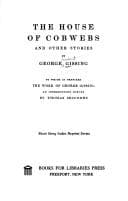
The House of Cobwebs and Other StoriesGissing, George
General
The House of Cobwebs and Other Stories
Gissing, George
Great Britain -- Social life and customs -- 19th century -- Fiction; Short stories
The grave reproof had exasperated him; he was flushed and his hands
trembled. I observed him with the utmost interest, and it became clear from
the angry words he poured forth that he could not endure to be supposed
anything but a gentleman at large. Here was the old characteristic; it had
merely been dormant. I tried to laugh him out of his irritation, but soon
saw that the attempt was dangerous. On the way home he talked very little;
the encounter in the wood had thoroughly upset him.
Next morning he came into my room with a laugh that I did not like; he
seated himself stiffly, looked at me from beneath his knitted brows, and
said in an aggressive tone:
'I have got to know all about that impudent old fellow.'
'Indeed? Who is he?'
'A poverty-stricken squire, with an old house and a few acres--the remnants
of a large estate gambled away by his father. I know him by name, and I'm
quite sure that he knows me. If I had offered him my card, as I thought of
doing, I dare say his tone would have changed.'
This pettishness amused me so much that I pretended to be a little sore
myself.
'His poverty, I suppose, has spoilt his temper.'
'No doubt,--I can understand that,' he added, with a smile. 'But I don't
allow people to treat me like a tramp. I shall go up and see him this
afternoon.'
'And insist on an apology?'
'Oh, there'll be no need of insisting. The fellow has several unmarried
daughters.'
It seemed to me that my companion was bent on showing his worst side. I
returned to my old thoughts of him; he was snobbish, insolent, generally
detestable; but a man to be studied, and I let him talk as he would.
The reduced squire was Mr. Humphrey Armitage, of Brackley Hall. For my own
part, the demeanour of this gentleman had seemed perfectly adapted to the
occasion; we were strangers plunging through his preserves, and his tone to
us had nothing improper; it was we who owed an apology. In point of
breeding, I felt sure that Ireton could not compare with Mr. Armitage for a
moment, and it seemed to me vastly improbable that the invader of Brackley
Hall would meet with the kind of reception he anticipated.
I saw Ireton when he set out to pay his call. His Gladstone-bags had
provided him with the costume of Piccadilly; from shining hat to
patent-leather shoes, he was immaculate. Seeing that he had to walk more
than a mile, that the month was September, and that he could not pretend to
have come straight from town, this apparel struck me as not a little
inappropriate; I could only suppose that the man had no social tact.
At seven in the evening he again sought me. His urban glories were
exchanged for the ordinary attire, but I at once read in his face that he
had suffered no humiliation.
'Come and dine with me at the inn,' he exclaimed cordially; 'if one may use
such a word as _dine_ under the circumstances.'
'With pleasure.'
'To-morrow I dine with the Armitages.'
Public-domain text, read in full here on John Shaqi.
Reviews
Reviews
No reviews yet
Be the first to share your thoughts on this work.
Elsewhere in the archive
Join the Discussion
Join the discussion
Sign in to leave a comment or review.
Sign InorCreate an account