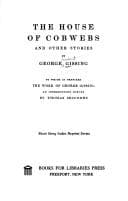
The House of Cobwebs and Other StoriesGissing, George
General
The House of Cobwebs and Other Stories
Gissing, George
Great Britain -- Social life and customs -- 19th century -- Fiction; Short stories
'That's the best part of my story,' said Ireton at length. 'What followed
is commonplace. Still, you might like to hear how I bridged the gulf, from
fourteen shillings a week to the position I now hold. Well, I got very
intimate with Crowther, and found him really a very decent fellow. He had a
good many irons in the fire. Besides his loan office, which paid much
better than you would imagine, he had a turf commission agency, which
brought him in a good deal of money, and shortly after I met him he became
part proprietor of a club in Soho. He very soon talked to me in the
frankest way of all his doings; I think he was glad to be on friendly terms
with me simply because I was better educated and could behave decently. I
don't think he ever did anything illegal, and he had plenty of good
feeling,--but that didn't prevent him from squeezing eighty per cent, or so
out of many a poor devil who had borrowed to save himself or his family
from starvation. That was all business; he drew the sharpest distinctions
between business and private relations, and was very ignorant. I never knew
a man so superstitious. Every day he consulted signs and omens. For
instance, to decide whether the day was to be lucky for him--in betting and
so on--he would stand at a street corner and count the number of white
horses that passed in five minutes; if he had made up his mind on an even
number, and an even number passed, then he felt safe in following his
impulses for the day; if the number were odd, he would do little or no
speculation. When he was going to play cards for money, he would find a
beggar and give him something, even if he had to walk a great distance to
do it. He often used to visit an Italian who kept fortune-telling canaries,
and he always followed the advice he got. It put him out desperately if he
saw the new moon through glass, or over his left shoulder. There was no end
to his superstitions, and, whether by reason of them or in spite of them,
he certainly prospered. When he died, ten or twelve years ago, he left
fifteen thousand pounds.
Public-domain text, read in full here on John Shaqi.
Reviews
Reviews
No reviews yet
Be the first to share your thoughts on this work.
Elsewhere in the archive
Join the Discussion
Join the discussion
Sign in to leave a comment or review.
Sign InorCreate an account