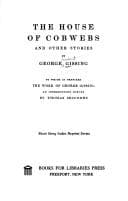
The House of Cobwebs and Other StoriesGissing, George
General
The House of Cobwebs and Other Stories
Gissing, George
Great Britain -- Social life and customs -- 19th century -- Fiction; Short stories
It did not appear to the lad that he had suffered any injustice. He knew
his own inaptitude for the higher kind of office work, and he had expected
his dismissal by Mr. Chadwick long before it came. What he did resent, and
profoundly, was Mr. Chadwick's refusal to aid his father in that last
death-grapple with ruinous circumstance. At the worst moment Harry wrote a
letter to Leonard Chadwick, whom he had never seen since he left school. He
told in simple terms the position of his family, and, without a word of
justifying reminiscence, asked his schoolfellow to help them if he could.
To this letter a reply came from London. Leonard Chadwick wrote briefly and
hurriedly, but in good-natured terms; he was really very sorry indeed that
he could do so little; the fact was, just now he stood on anything but good
terms with his father, who kept him abominably short of cash. He enclosed
five pounds, and, if possible, would soon send more.
'Don't suppose I have forgotten what I owe you. As soon as ever I find
myself in an independent position you shall have substantial proof of my
enduring gratitude. Keep me informed of your address.'
Humplebee made no second application, and Leonard Chadwick did not again
break silence.
The years flowed on. At five-and-twenty Humplebee toiled in the same
office, but he could congratulate himself on a certain progress; by dogged
resolve he had acquired something like efficiency in the duties of a
commercial clerk, and the salary he now earned allowed him to contribute to
the support of his mother. More or less reconciled to the day's labour, he
had resumed in leisure hours his favourite study; a free library supplied
him with useful books, and whenever it was possible he went his way into
the fields, searching, collecting, observing. But his life had another
interest, which threatened rivalry to this intellectual pursuit. Humplebee
had set eyes upon the maiden destined to be his heart's desire; she was the
daughter of a fellow-clerk, a man who had grown grey in service of the
ledger; timidly he sought to win her kindness, as yet scarce daring to
hope, dreaming only of some happy change of position which might encourage
him to speak. The girl was as timid as himself; she had a face of homely
prettiness, a mind uncultured but sympathetic; absorbed in domestic cares,
with few acquaintances, she led the simplest of lives, and would have been
all but content to live on in gentle hope for a score of years. The two
were beginning to understand each other, for their silence was more
eloquent than their speech.
Public-domain text, read in full here on John Shaqi.
Reviews
Reviews
No reviews yet
Be the first to share your thoughts on this work.
Elsewhere in the archive
Join the Discussion
Join the discussion
Sign in to leave a comment or review.
Sign InorCreate an account