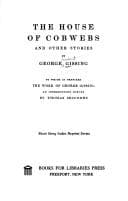
The House of Cobwebs and Other StoriesGissing, George
General
The House of Cobwebs and Other Stories
Gissing, George
Great Britain -- Social life and customs -- 19th century -- Fiction; Short stories
Mr. Whiston shrank from society, ceaselessly afraid of receiving less than
his due; privately, meanwhile, he deplored the narrowness of the social
opportunities granted to his daughter, and was for ever forming schemes for
her advantage--schemes which never passed beyond the stage of nervous
speculation. They inhabited a little house in a western suburb, a house
illumined with every domestic virtue; but scarcely a dozen persons crossed
the threshold within a twelvemonth. Rose's two or three friends were, like
herself, mistrustful of the world. One of them had lately married after a
very long engagement, and Rose still trembled from the excitement of that
occasion, still debated fearfully with herself on the bride's chances of
happiness. Her own marriage was an event so inconceivable that merely to
glance at the thought appeared half immodest and wholly irrational.
Every winter Mr. Whiston talked of new places which he and Rose would visit
when the holidays came round; every summer he shrank from the thought of
adventurous novelty, and ended by proposing a return to the same western
seaside-town, to the familiar lodgings. The climate suited neither him nor
his daughter, who both needed physical as well as moral bracing; but they
only thought of this on finding themselves at home again, with another long
year of monotony before them. And it was so good to feel welcome,
respected; to receive the smiling reverences of tradesfolk; to talk with
just a little well-bred condescension, sure that it would be appreciated.
Mr. Whiston savoured these things, and Rose in this respect was not wholly
unlike him.
To-day was the last of their vacation. The weather had been magnificent
throughout; Rose's cheeks were more than touched by the sun, greatly to the
advantage of her unpretending comeliness. She was a typical English maiden,
rather tall, shapely rather than graceful, her head generally bent, her
movements always betraying the diffidence of solitary habit. The lips were
her finest feature, their perfect outline indicating sweetness without
feebleness of character. Such a girl is at her best towards the stroke of
thirty. Rose had begun to know herself; she needed only opportunity to act
upon her knowledge.
A train would take them back to the seaside. At the railway station Rose
seated herself on a shaded part of the platform, whilst her father, who was
exceedingly short of sight, peered over publications on the bookstall.
Rather tired after her walk, the girl was dreamily tracing a pattern with
the point of her parasol, when some one advanced and stood immediately in
front of her. Startled, she looked up, and recognised the red-haired
stranger of the inn.
'You left these flowers in a glass of water on the table. I hope I'm not
doing a rude thing in asking whether they were left by accident.'
Public-domain text, read in full here on John Shaqi.
Reviews
Reviews
No reviews yet
Be the first to share your thoughts on this work.
Elsewhere in the archive
Join the Discussion
Join the discussion
Sign in to leave a comment or review.
Sign InorCreate an account