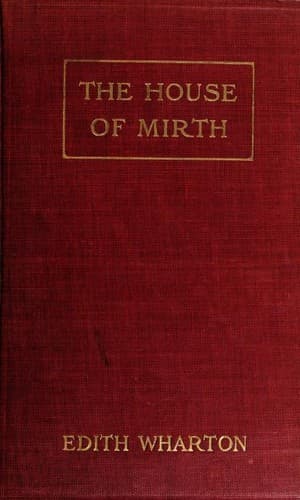
New York (N.Y.) -- Fiction; Psychological fiction; Single women -- Fiction; Social classes -- Fiction
Lily found Mrs. Peniston in a state of agitation. She had sent for
Grace Stepney and was taking digitalis. Lily breasted the storm of
enquiries as best she could, explaining that she had had an attack
of faintness on her way back from Carry Fisher’s; that, fearing
she would not have strength to reach home, she had gone to Miss
Farish’s instead; but that a quiet night had restored her, and that
she had no need of a doctor.
This was a relief to Mrs. Peniston, who could give herself up
to her own symptoms, and Lily was advised to go and lie down,
her aunt’s panacea for all physical and moral disorders. In
the solitude of her own room she was brought back to a sharp
contemplation of facts. Her daylight view of them necessarily
differed from the cloudy vision of the night. The winged furies
were now prowling gossips who dropped in on each other for tea. But
her fears seemed the uglier, thus shorn of their vagueness; and
besides, she had to act, not rave. For the first time she forced
herself to reckon up the exact amount of her debt to Trenor; and
the result of this hateful computation was the discovery that she
had, in all, received nine thousand dollars from him. The flimsy
pretext on which it had been given and received shrivelled up
in the blaze of her shame: she knew that not a penny of it was
her own, and that to restore her self-respect she must at once
repay the whole amount. The inability thus to solace her outraged
feelings gave her a paralyzing sense of insignificance. She was
realizing for the first time that a woman’s dignity may cost more
to keep up than her carriage; and that the maintenance of a moral
attribute should be dependent on dollars and cents, made the world
appear a more sordid place than she had conceived it.
After luncheon, when Grace Stepney’s prying eyes had been
removed, Lily asked for a word with her aunt. The two ladies
went upstairs to the sitting-room, where Mrs. Peniston seated
herself in her black satin arm-chair tufted with yellow buttons,
beside a bead-work table bearing a bronze box with a miniature
of Beatrice Cenci in the lid. Lily felt for these objects the
same distaste which the prisoner may entertain for the fittings
of the court-room. It was here that her aunt received her rare
confidences, and the pink-eyed smirk of the turbaned Beatrice was
associated in her mind with the gradual fading of the smile from
Mrs. Peniston’s lips. That lady’s dread of a scene gave her an
inexorableness which the greatest strength of character could not
have produced, since it was independent of all considerations of
right or wrong; and knowing this, Lily seldom ventured to assail
it. She had never felt less like making the attempt than on the
present occasion; but she had sought in vain for any other means of
escape from an intolerable situation.
Mrs. Peniston examined her critically. “You’re a bad colour, Lily:
this incessant rushing about is beginning to tell on you,” she said.
Public-domain text, read in full here on John Shaqi.
Reviews
Reviews
No reviews yet
Be the first to share your thoughts on this work.
Elsewhere in the archive
Join the Discussion
Join the discussion
Sign in to leave a comment or review.
Sign InorCreate an account