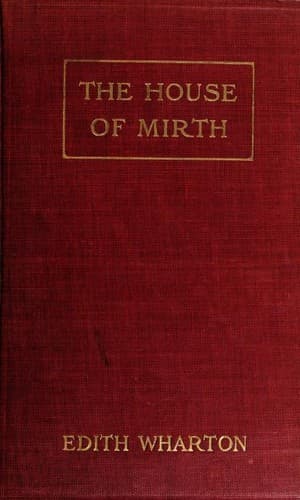
New York (N.Y.) -- Fiction; Psychological fiction; Single women -- Fiction; Social classes -- Fiction
Mrs. Haffen raised a suspicious glance: she was too experienced not
to know that the traffic she was engaged in had perils as great as
its rewards, and she had a vision of the elaborate machinery of
revenge which a word of this commanding young lady’s might set in
motion.
She applied the corner of her shawl to her eyes, and murmured
through it that no good came of bearing too hard on the poor, but
that for her part she had never been mixed up in such a business
before, and that on her honour as a Christian all she and Haffen
had thought of was that the letters mustn’t go any farther.
Lily stood motionless, keeping between herself and the char-woman
the greatest distance compatible with the need of speaking in low
tones. The idea of bargaining for the letters was intolerable to
her, but she knew that, if she appeared to weaken, Mrs. Haffen
would at once increase her original demand.
She could never afterward recall how long the duel lasted, or
what was the decisive stroke which finally, after a lapse of time
recorded in minutes by the clock, in hours by the precipitate beat
of her pulses, put her in possession of the letters; she knew only
that the door had finally closed, and that she stood alone with the
packet in her hand.
She had no idea of reading the letters; even to unfold Mrs.
Haffen’s dirty newspaper would have seemed degrading. But what did
she intend to do with its contents? The recipient of the letters
had meant to destroy them, and it was her duty to carry out his
intention. She had no right to keep them—to do so was to lessen
whatever merit lay in having secured their possession. But how
destroy them so effectually that there should be no second risk of
their falling in such hands? Mrs. Peniston’s icy drawing-room grate
shone with a forbidding lustre: the fire, like the lamps, was never
lit except when there was company.
Miss Bart was turning to carry the letters upstairs when she
heard the opening of the outer door, and her aunt entered the
drawing-room. Mrs. Peniston was a small plump woman, with a
colourless skin lined with trivial wrinkles. Her grey hair was
arranged with precision, and her clothes looked excessively new
and yet slightly old-fashioned. They were always black and tightly
fitting, with an expensive glitter: she was the kind of woman who
wore jet at breakfast. Lily had never seen her when she was not
cuirassed in shining black, with small tight boots, and an air of
being packed and ready to start; yet she never started.
She looked about the drawing-room with an expression of minute
scrutiny. “I saw a streak of light under one of the blinds as I
drove up: it’s extraordinary that I can never teach that woman to
draw them down evenly.”
Having corrected the irregularity, she seated herself on one of
the glossy purple arm-chairs; Mrs. Peniston always sat on a chair,
never in it.
Public-domain text, read in full here on John Shaqi.
Reviews
Reviews
No reviews yet
Be the first to share your thoughts on this work.
Elsewhere in the archive
Join the Discussion
Join the discussion
Sign in to leave a comment or review.
Sign InorCreate an account