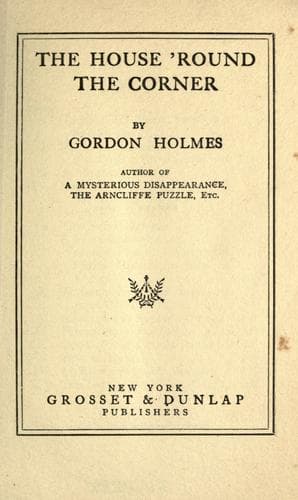
Mystery fiction; Yorkshire (England) -- Social life and customs -- Fiction
"Was Miss Meg friendly with the Burts?" inquired Armathwaite, when he
and Betty realized it was useless to gaze expectantly either at the
corner of the roadway visible from the porch, or at such small
cross-sections of the village "street" as could be seen at irregular
intervals between the houses.
"Yes, sir. She'd often walk over there," said the girl, gazing at once
in the direction of the Castle Farm, which was the name of the holding.
"She would know that breakfast was on the way?"
"Oh, yes, sir! I axed her meself when I brought her a cup of tea. She
said that nine o'clock would suit."
Betty turned involuntarily to consult the grandfather's clock in the
hall. The hands stood at ten minutes past nine; but, in the same moment,
she remembered that the clock was not going. Armathwaite followed her
glance, and looked at his watch.
"Ten minutes past nine," he answered, with a laugh. "The old clock is
right to a tick. Was it in use while the Sheffield lady remained in the
house?"
"No, sir. It stopped at that time when the old man died."
Then she giggled. There is hardly a man or woman in Yorkshire who does
not know that the words of a famous song were suggested by the behavior
of a clock which is still exhibited in an inn on the south side of the
Tees at Pierce Bridge, and the girl had unconsciously repeated the tag
of verses and chorus.
Armathwaite had yet to learn of this treasured possession of the county
of broad acres, so he eyed Betty rather disapprovingly. Moved by an
impulse which he regarded as nothing more than a desire to check such
undue levity, he strode into the hall, found a key resting on a ledge
of the clock's canopy, wound up the heavy weights, and started the
pendulum.
"Perhaps our ancient friend may be more accurate than you, Betty," he
said. "You mean, I suppose, that it stopped at that time because it was
not wound. How do _you_ know the hour, or even the day, anyone died
here?"
"Well, I don't, sir, an' that's a fact," she admitted. "But what about
breakfast?"
"Attend to Mr. Whittaker--I'll wait!"
He went out again, and saw Smith hobbling down the bye-road.
"Hi!" he cried, "if you're going into the village you might ask if
anyone has seen Miss Meg!"
Smith replied with a hand wave. He was thinking mainly of begonias,
planning a magician's stroke, because his new master had told him to
spare no expense. Within ten minutes he returned, but not alone. Four
able-bodied rustics came with him, each carrying a spade or a garden
fork. But he had not forgotten Armathwaite's request.
"Miss Meg hasn't gone that way, sir," he said. "Plenty of folk saw her
in t' garden, an' they couldn't ha' missed her had she been in t'
street. But she'll be comin' i' now. No fear o' her bein' lost, stolen,
or strayed i' Elmdale. These chaps are good for a day's diggin' at four
shillin' an' two quarts o' beer each. Is that right, sir?"
"Make it five shillings and no beer," said Armathwaite.
The laborers grinned.
Public-domain text, read in full here on John Shaqi.
Reviews
Reviews
No reviews yet
Be the first to share your thoughts on this work.
Elsewhere in the archive
Join the Discussion
Join the discussion
Sign in to leave a comment or review.
Sign InorCreate an account