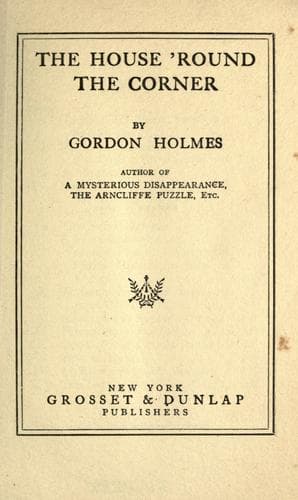
Mystery fiction; Yorkshire (England) -- Social life and customs -- Fiction
_G._--Mrs. Ogilvey, a most estimable lady, and quite as unlikely as
her scholar-husband to be associated with a crime, was a party to
all these mysterious proceedings, and the combined object of
husband and wife was to keep their daughter in ignorance of the
facts for a time, at least, if not forever.
"I don't think I need carry the demonstration any further to-night. You
are not to retire to your room and sob yourself into a state of hysteria
because your coming to Elmdale has threatened with destruction an
edifice of deceit built with such care and skill. I am beginning to
recognize now a fatalistic element in the events of the past twenty-four
hours that suggests the steady march of a Greek tragedy to its
predestined end. But the dramatic art has undergone many changes since
the days of Euripides. Let's see if we cannot avail ourselves of modern
methods, and keep the tragic _denouement_ in the place where it has been
put already, namely, in Bellerby churchyard."
The girl stood up, and gave him her hand.
"I'm almost certain, Bob, that if you and dad had five minutes' talk,
there would be an end of the mystery," she said.
"And a commencement of a long friendship, I hope," he said.
Their eyes met, and Meg's steady gaze faltered for the first time. She
almost ran out of the room, and Armathwaite sat many minutes in utter
stillness, looking through the window at the dark crest of the moor
silhouetted against a star-lit sky. Then he refilled his pipe, and
picked up the book he had taken haphazard from the well-stored shelves
of that curiously constituted person, Stephen Ogilvey.
It was a solid tome, entitled: "Scottish Criminal Trials," and lay side
by side with "The Golden Bough," which Marguerite had spoken of, and a
German work, "Geschichte des Teufels." Turning over the leaves, he found
that someone had marked a passage with ink. The reference had been noted
many years ago, because the marks were faded and brown, but the
paragraph thus singled out had an extraordinary vivid bearing on the
day's occurrences.
It read:
"A statute of James I., still in force, enacts that all persons
invoking an evil spirit, or consulting, covenanting with,
entertaining, employing, feeding or rewarding any evil spirit,
shall be guilty of felony and suffer death."
Instantly there flitted before Armathwaite's vision a picture of the
besotted Faulkner offering libations of wine to the black figure
scowling from the stained-glass window. Perhaps the old toper had been
lifting his head in a final bumper when he fell backward down the stairs
and broke his neck.
Armathwaite shut the book with a bang. When he went out, he found that
Betty had forgotten to leave a candle in the hall, and he must either
go upstairs in the dark or carry with him the lamp still burning on its
bracket.
He glared steadily at the dull outline of the effigy in armor.
Public-domain text, read in full here on John Shaqi.
Reviews
Reviews
No reviews yet
Be the first to share your thoughts on this work.
Elsewhere in the archive
Join the Discussion
Join the discussion
Sign in to leave a comment or review.
Sign InorCreate an account