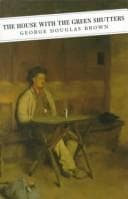
The House with the Green ShuttersBrown, George Douglas
General
The House with the Green Shutters
Brown, George Douglas
Scotland -- Social life and customs -- 19th century -- Fiction
Young Gourlay had found a means of escaping from his foolish mind. By
the beginning of his second session he was as able a toper as a publican
could wish. The somewhat sordid joviality of Allan's ring, their
wit-combats that were somewhat crude, appeared to him the very acme of
social intercourse. To emulate Logan and Allan was his aim. But drink
appealed to him in many ways besides. Now when his too apprehensive
nerves were frightened by bugbears in his lonely room he could be off to
the Howff and escape them. And drink inspired him with false courage to
sustain his pose as a hardy rollicker. He had acquired a kind of
prestige since the night of Allan's party, and two of the fellows whom
he met there--Armstrong and Gillespie--became his friends at College and
the Howff. He swaggered before them as he had swaggered at school both
in Barbie and Skeighan, and now there was no Swipey Broon to cut him
over the coxcomb. Armstrong and Gillespie--though they saw through
him--let him run on, for he was not bad fun when he was splurging. He
found, too, when with his cronies that drink unlocked his mind, and gave
a free flow to his ideas. Nervous men are often impotent of speech from
very excess of perception; they realize not merely what they mean to
say, but with the nervous antennae of their minds they feel the attitude
of every auditor. Distracted by lateral perceptions from the point
ahead, they blunder where blunter minds would go forward undismayed.
That was the experience of young Gourlay. If he tried to talk freely
when sober, he always grew confused. But drink deadened the outer rim of
his perception and left it the clearer in the middle for its
concentration. In plainer language, when he was drunk he was less afraid
of being laughed at, and free of that fear he was a better speaker. He
was driven to drink, then, by every weakness of his character. As
nervous hypochondriac, as would-be swaggerer, as a dullard requiring
stimulus, he found that drink, to use his own language, gave him
"smeddum."
With his second year he began the study of philosophy, and that added to
his woes. He had nerves to feel the Big Conundrum, but not the brains to
solve it; small blame to him for that, since philosophers have cursed
each other black in the face over it for the last five thousand years.
But it worried him. The strange and sinister detail of the world, that
had always been a horror to his mind, became more horrible beneath the
stimulus of futile thought. But whisky was the mighty cure. He was the
gentleman who gained notoriety on a memorable occasion by exclaiming,
"Metaphysics be damned; let us drink!" Omar and other bards have
expressed the same conclusion in more dulcet wise. But Gourlay's was
equally sincere. How sincere is another question.
Curiously, an utterance of "Auld Tam," one of his professors, half
confirmed him in his evil ways.
Public-domain text, read in full here on John Shaqi.
Reviews
Reviews
No reviews yet
Be the first to share your thoughts on this work.
Elsewhere in the archive
Join the Discussion
Join the discussion
Sign in to leave a comment or review.
Sign InorCreate an account